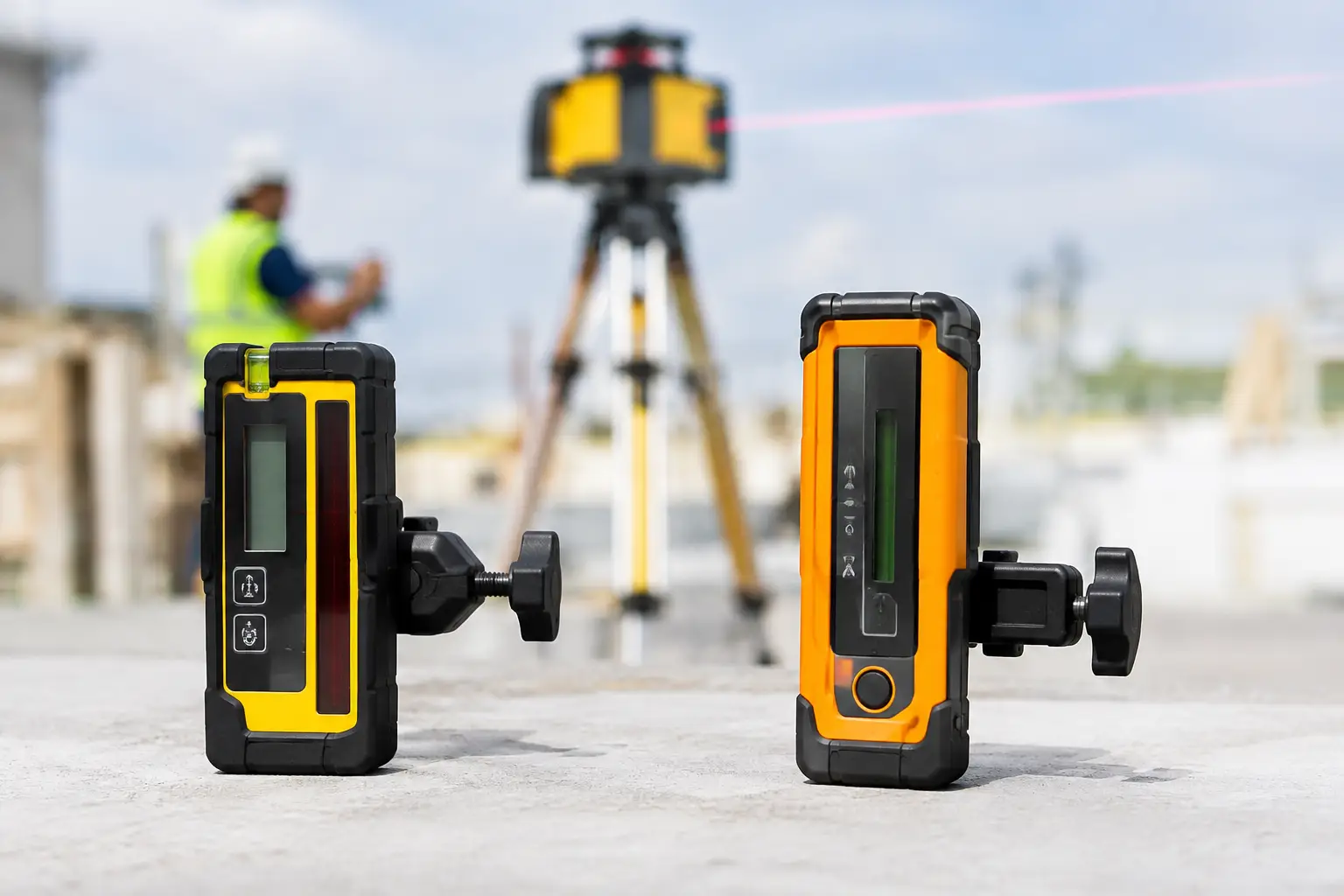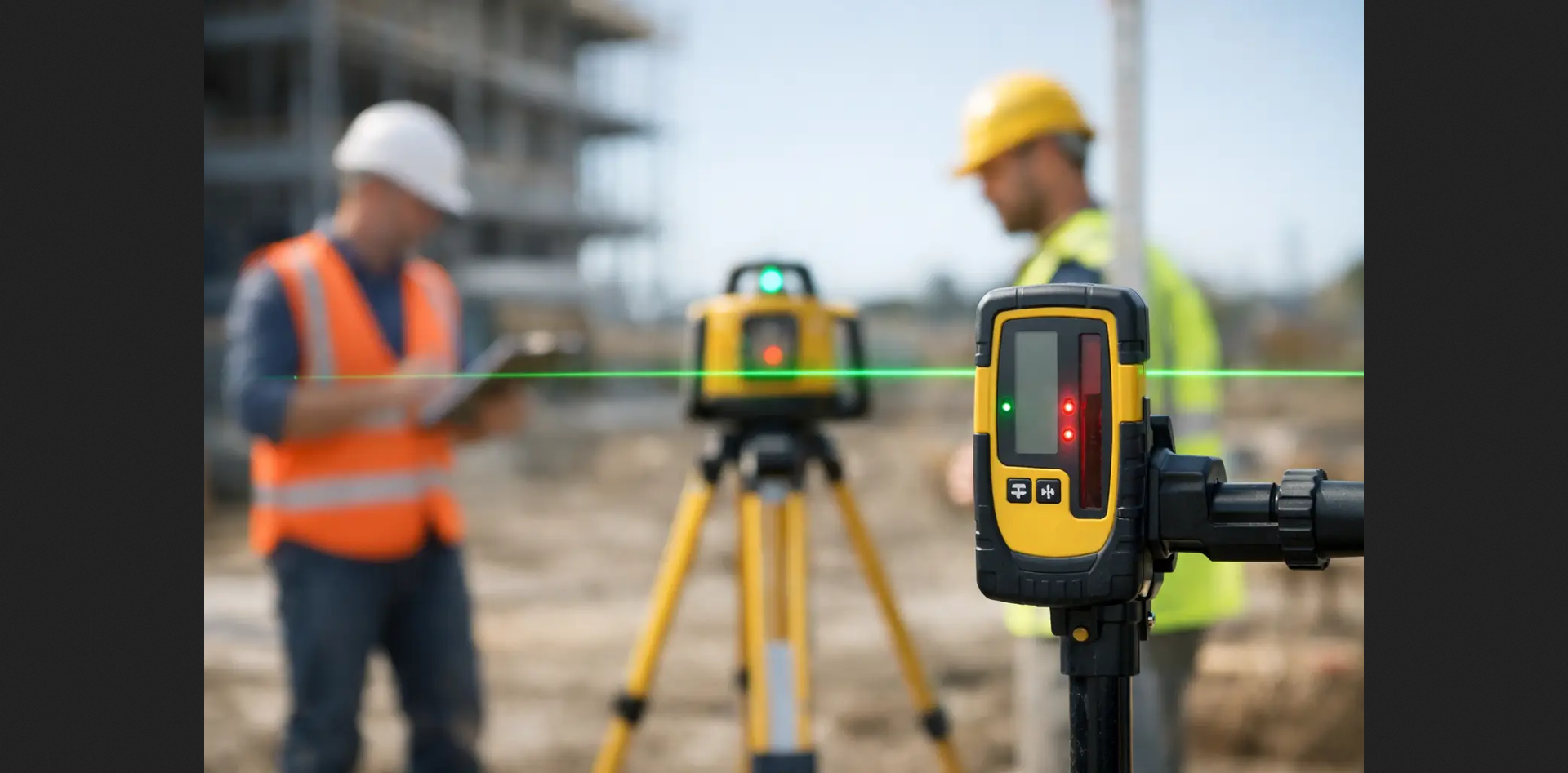
When the rotating laser is not visible in direct sunlight, the work does not end. That is when it is important to use the laser receiver . The receiver captures the plane created by the rotating laser, guides you to the correct height with sound and arrows, and allows you to work accurately even at tens or hundreds of meters. When excavating, concreting, building foundations or laying sewers, it is an essential accessory, not an extra.
The laser receiver is used together with the rotating laser and is most often mounted on a leveling staff. The laser creates a horizontal, vertical or inclined plane. The receiver then shows whether you are below, above or exactly at the plane. This means that you do not read the beam with your eyes, but work according to clear signals.
How to use a laser receiver step by step
First, place the rotating laser on a solid surface or tripod. When working with heights, the laser must be away from where it can be hit by a vibrating plate, excavator or moving material. After switching on, let the self-leveling device complete the leveling. If it indicates that the tilt range has been exceeded, adjust the tripod or surface before starting to measure.
Then turn on the receiver. Most models have a separate button for power on, accuracy selection and an audible signal. For general earthwork and rough concrete work, a wider accuracy range is suitable so that the receiver responds more calmly. When setting curbs, assembling structures or checking formwork, set the finer accuracy. The measurement will be more sensitive, but requires a firmer grip on the staff.
Attach the receiver to the staff using the bracket . Its scanning window must face the rotating laser and the staff must be as vertical as possible. A tilted staff changes the measured height. A difference of a few centimeters in working height can make a noticeable difference with a longer staff, so it is worth checking the bubble on the staff or working with someone who has practiced the correct posture.
Move the staff up or down until the receiver indicates the center. A typical receiver uses arrows on the display and an intermittent tone. One arrow indicates that you need to go higher, the other lower. A center line or continuous tone indicates that the laser plane is exactly level. At that point, read the value on the staff or mark a point on the structure.
When working in pairs, the process is quick. One worker controls the laser and determines the reference height, the other transfers the height with the staff and receiver. For a large area, it is a good idea to first mark several control points. Only then start with the excavation, subsoil or concreting. This saves repeated measurements and repairs to the finished work.
The reference point decides the outcome
The receiver may be accurate, but without a properly established reference point, the entire height will be incorrect. So before you start, make sure you know where you are measuring from. This could be the design height, a fixed point from a surveyor, the finished floor, the top edge of the foundation strip, or a marked point on the wall.
Example when pouring a foundation slab: you place the laser outside the concrete area, set the receiver on the batten to the desired height of the concrete, and mark this position. When the worker then moves the batten across the area, the center signal of the receiver shows where the resulting height should be. If the receiver is above level at the same position on the batten, the base or concrete is too high. If it is below level, the material is missing.
In excavations, the principle works the same way, only instead of the finished level, you are looking at the bottom of the excavation. However, in sewerage, you often work with a slope. Here, a simple horizontal rotating laser is not enough if you want to set the exact slope in the axis. You need a slope or digital rotating laser that can set the slope value in the X and Y axes. The receiver then still searches for its laser plane, but the plane itself is no longer horizontal.
A conventional and a digital receiver are not the same thing
The standard laser receiver guides you to the center with a signal and arrows. It is a practical and quick solution for most construction work. When transferring heights to foundation strips, landscaping, installing plasterboard profiles in a larger room or checking formwork, you usually don't need anything more.
The digital receiver also displays the deviation from the center in millimeters. Instead of the information "go lower", you see, for example, that you are 12 mm above the plane. This speeds up height adjustment and reduces guesswork during delicate work. It is especially suitable for construction teams that often deal with precise heights, excavations, subgrades, concrete surfaces or the installation of elements according to the project.
However, it should be noted that a digital reading is not a substitute for proper working procedures. If the staff is tilted, the receiver holder is loose, or the laser has changed position after being struck, the millimeter display will only show you a very precisely measured error. The accuracy of the system is always determined by the laser, the receiver, the staff, and the person working with them.
Sensitivity and sound settings in practice
Adjust the receiver sensitivity to your work tolerance. Coarse mode has a wider band around the center. The receiver will not beep for every small movement of the batten, which is an advantage when compacting gravel, rough grading or in wind. Fine mode has a narrow band and is designed for where millimeters matter.
The audible signal is especially important outdoors. If a worker is watching an excavator bucket, formwork or concrete surface, they do not need to constantly look at the display. Adjust the volume so that the tone can be heard over normal construction noise but does not interrupt communication on the jobsite. In confined spaces, a quieter mode or the display itself is often sufficient.
In strong sunlight, the color of the beam is not as important when working with the receiver as it is when working with the naked eye. The green beam is usually better visible, but an external receiver is required for both red and green rotating lasers when leveling outdoors. It is important to check compatibility. Not every receiver works with every laser, especially with a green beam or with a different rotation frequency.
The most common errors when working with the receiver
If the receiver does not respond, do not immediately start complaining about the device. Check the basic things that cause most problems on the construction site:
- the laser is turned on, leveled and actually rotating,
- the receiver is turned with the sensing window towards the laser,
- the batteries or accumulator have sufficient charge,
- the distance does not exceed the working range of the assembly,
- The receiver is set to the correct beam type and is not covered by a dirty window.
Another common mistake is moving the tripod after establishing the reference height. A slight bump or the tripod leg sinking into soft soil is enough to shift the entire plane. Therefore, at critical heights, regularly check the starting point during work. It is faster than repairing a poorly concreted step, subgrade or pipe.
Also be careful when measuring near obstacles. The receiver needs direct contact with the plane of rotation. If its path is blocked by a machine, a pallet of material, a wall or a person standing close to the batten, the signal may drop out. In this case, change the location of the laser, the height of the tripod or the workflow.
Checking accuracy before important work
A new rotating laser should be calibrated before use, but it is still a good idea to check on site. Place the laser between two fixed points approximately 20 to 30 meters apart. Use the receiver to mark the height at both points. Then move the laser closer to one of the points and repeat the measurement. Compare the differences according to the procedure in the specific device's manual.
Such an inspection will reveal whether the laser has suffered a fall, a strong shock during transportation or unprofessional intervention. It is advisable to keep the receiver clean, do not leave it loose in the trunk of a car and store it in a case after work. Dust on the sensor window, a damaged holder or a weak battery often unnecessarily slow down the morning start to the construction site.
If you are using the receiver for the first time, try it out on a flat surface before doing any serious work. After a few minutes, you will know how quickly it responds in fine and coarse mode, where the center is, and what position on the staff you need for a specific height. At Rotary Lasers - Levels, you can try the device in person and have the settings explained to you according to the type of work you are doing. A properly adjusted laser, a fixed staff, and a receiver in the center of the signal are the little things that decide the exact result on a construction site.