When it comes to choosing between a green or red rotating laser, the color of the beam is not the only factor. It is whether you are plastering a hall, pouring concrete into a foundation in direct sunlight, laying curbs or adjusting the slope of a sewer. A poorly chosen type may not measure inaccurately, but it may slow you down unnecessarily. On the contrary, a correctly chosen laser will allow you to work quickly, confidently and without constant re-measurement.
The rotating laser creates a horizontal plane by rotating the laser beam through 360 degrees. After placing it on a tripod and automatically self-leveling, you have a fixed height reference for the entire work surface. With models with inclinations, the plane can be consciously tilted in the X, Y or both axes. The color of the beam is important mainly for its visibility, not for the measuring principle itself.
Green or red rotating laser: the fundamental difference
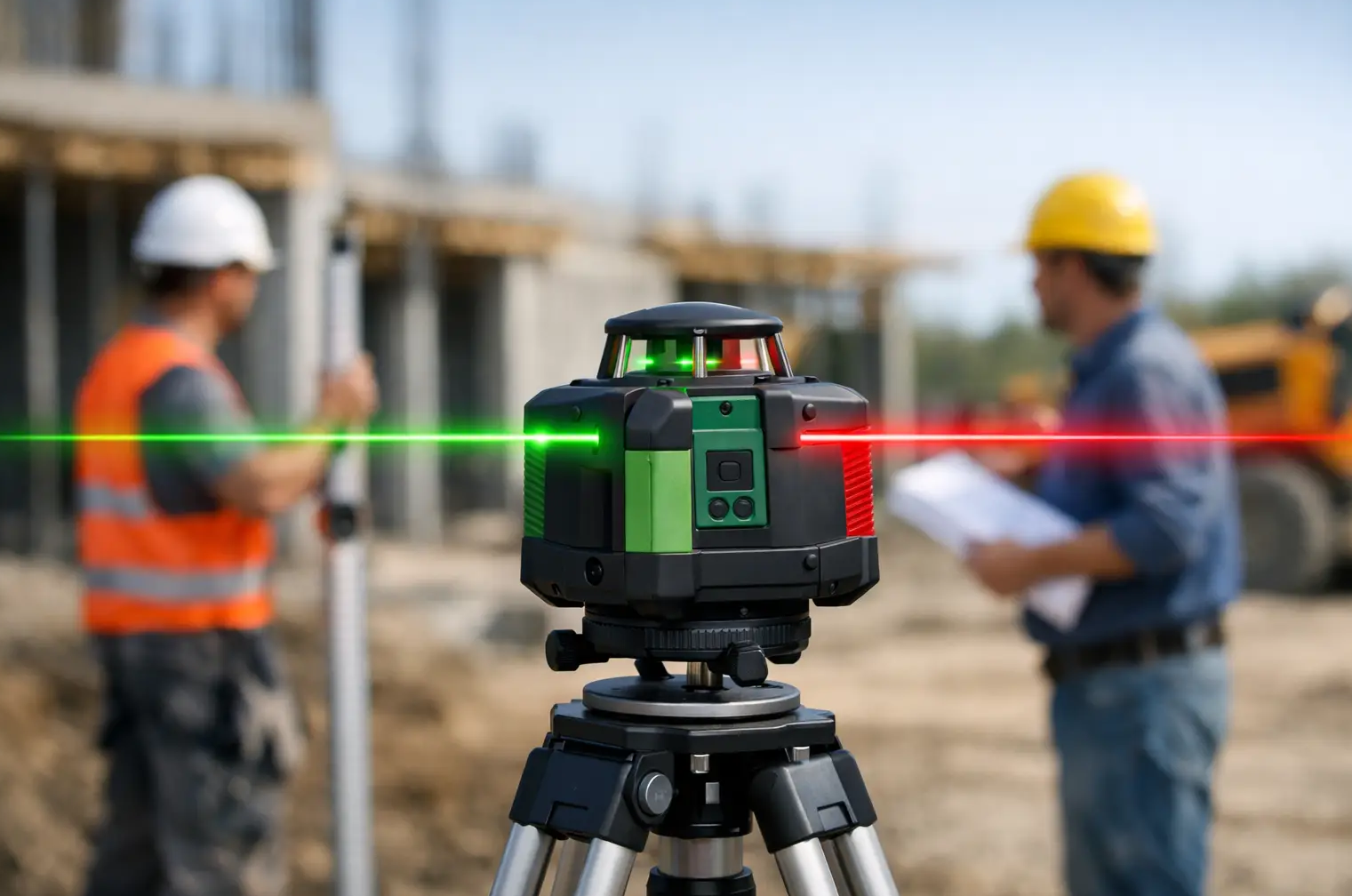
The green beam is perceived by the human eye more clearly than red. Indoors, in the shade or when working at shorter distances, you can often see it better directly on the wall, profile or structure. It is practical when installing suspended ceilings, partitions, cladding, shelving, steel elements or when transferring heights in a confined space.
The red rotating laser has a less visible beam to the eye, but this does not automatically mean a worse result. When working with an external receiver, it can work accurately even on large construction sites and outdoors. For earthworks, excavations, foundations, concreting or setting curbs, it is often a more sensible and cost-effective choice.
Two concepts need to be separated: beam visibility and measuring range. A green beam may be more visible to the naked eye, but the actual working range of a rotating laser outdoors is mainly determined by the quality and type of receiver. In the sun, you cannot work reliably with your eyes, even with a green beam. That is where a receiver for a laser staff belongs.
In the sun, it's the receiver that matters, not the color of the beam
When working outdoors, it often happens that the customer wants a green laser because they expect the beam to be visible even in direct sunlight. In practice, this does not work. In strong daylight, the beam is difficult to see or completely invisible even with a green model at a greater distance.
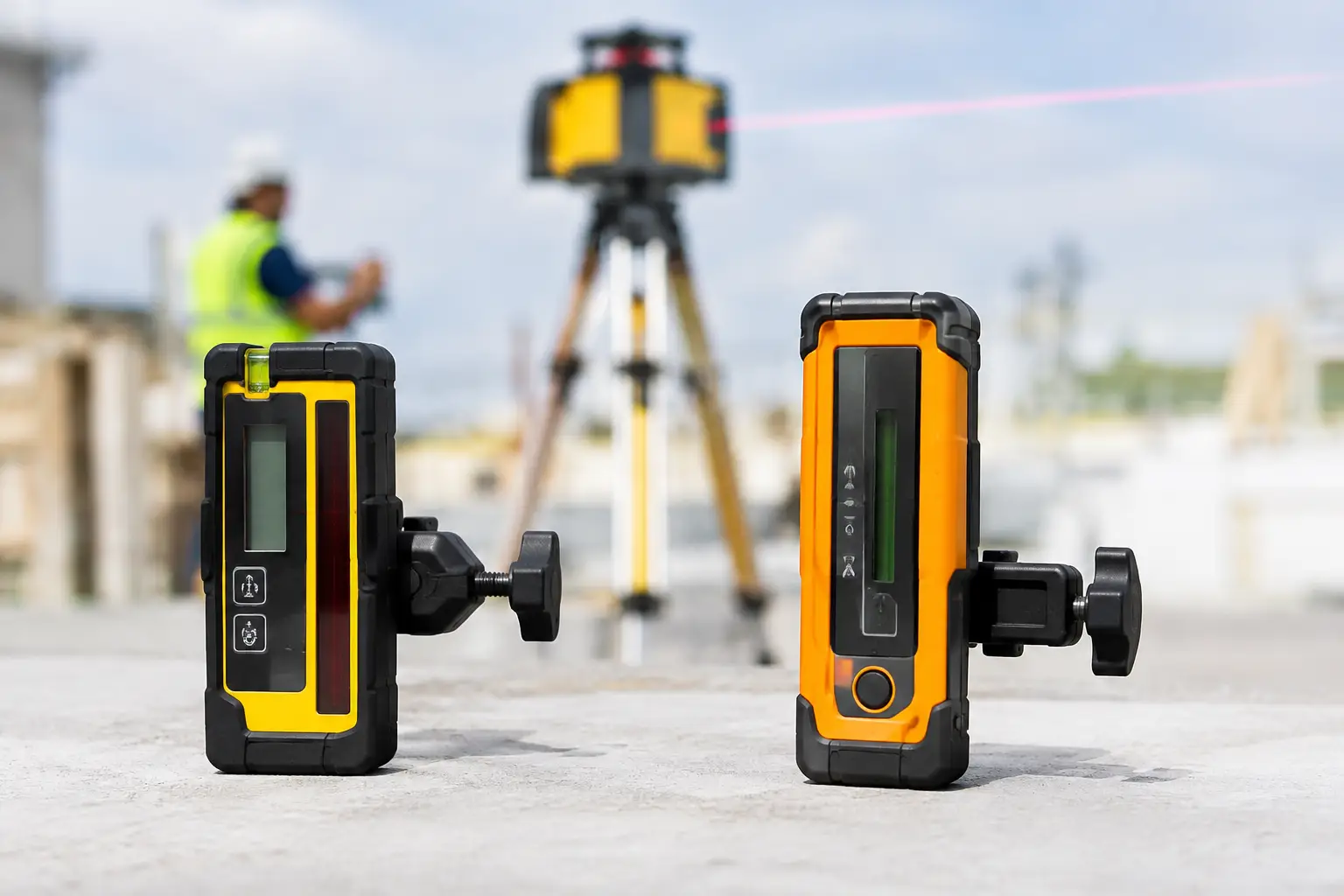
The solution is an external receiver. It captures the plane of the rotating laser, and indicates audibly and visually whether you are above, below, or exactly in the middle of the plane. With the right receiver, you can stake out heights of tens to hundreds of meters, depending on the specific model and conditions on the site.
For normal construction work, a standard receiver with center indication is sufficient. However, if you need to check heights more precisely, a digital sensor with millimeter reading is worth it. The display shows not only the direction, but also the specific deviation from the laser plane. When pouring concrete, setting footings, inspecting the excavation or laying pipes, this saves time and repeated measurements.
When does a green rotating laser have a clear advantage?
A green rotating laser is worth it where you often work indoors and want to see a line or point without holding the receiver. It is more convenient for assembly work. The craftsman can quickly transfer the height around the room, check the plane of the structure or set several elements to the same level.
It also has advantages in partially shaded areas, in garages, halls, basements, during renovations and when working under a roof. However, this does not mean that you do not need a receiver. If the distance increases, the light is strong or you need an exact height on the batten, the receiver remains the right working tool.
When choosing a green model, look at the leveling accuracy, self-leveling range, coverage, battery capacity, and availability of accessories. The green color alone is no substitute for a quality device, pre-calibration, or service. A laser that is clearly visible but lacks proven accuracy will not help on a construction site.
Assembly example
When installing a plasterboard ceiling in a family home, a green rotating laser is a nice helper. You place it approximately in the middle of the room, let it level automatically, and transfer the perimeter height directly to the walls. At shorter distances, the work is quick and one person can handle more tasks without assistance.
However, if you take the same device to an open area when you are building a structure, you will switch to working with a receiver and a batten. At that point, the difference in color visibility no longer plays such a big role.
When is a red rotating laser more practical?
The red rotating laser offers a very good price-performance ratio for companies and tradespeople who spend most of their time working outdoors with a receiver. Typical tasks include excavation, earthworks, foundation work, concreting, landscaping, paving, or checking heights over a larger area.
If you are not following the beam with the naked eye, but with a receiver, the red version will do the same job accurately and reliably. You can better use the difference in purchase price on a quality tripod, telescopic staff, digital receiver or spare battery. These are things that will be immediately noticeable in everyday work.
The red model is also suitable for the customer who needs a universal first rotation laser. In combination with a tripod, 5-meter staff and receiver, you get a complete set for most height work on construction sites. When choosing, do not skimp on accessories. An unstable tripod or damaged staff can ruin even a good measurement.
For gradients, color is not enough, you need a gradient model
If you're dealing with sewers, drainage, driveways, terrain slopes, or precise grades in concrete, don't just choose a laser based on the color of the beam. You need a model that can adjust the slope in the X and Y axes. A typical self-leveling rotating laser will maintain a horizontal plane, but it can't accurately tilt it to the desired value without additional features.
The digital rotating laser allows you to enter or set the slope in percentages according to the specific job. This means you don't have to improvise with a tripod and repeatedly check the heights when laying pipes. You set the desired slope, work with the staff and receiver, and continuously verify the result.
For simple one-way gradients, the basic slope mode may be sufficient. For more complex terrains where you need to deal with two axes at once, a digital model is more accurate and convenient. It is more expensive, but when working with gradients regularly, the investment returns in speed and less risk of error.
Don't choose just by color
Before ordering, ask yourself a simple question: how will you use the laser most of the time? If you work indoors, in assemblies and under supervision, the green beam will bring you better comfort. If you work mostly outdoors on a staff with a receiver, the red laser will provide accurate measurements at a more affordable price. In the sun, the receiver is mandatory for both colors.
Also important is the declared accuracy, for example in millimeters at a certain distance, the working range with the receiver, the range of automatic leveling, protection against dust and splash water, the operating temperature and the power supply. For construction, it is practical when the battery can be easily charged or replaced and when holders, chargers, receivers or spare parts are in stock.
Every rotating laser is worth checking before use. Place it on a solid surface, let it self-level, and for important jobs, verify the height by rotating the device in several directions. Regular checking and calibration are cheaper than repairing poorly installed components or complaining about the finished work.
At Rotary Lasers - Levels, we deliver new devices pre-calibrated and advise according to the specific job, not just the product name. If you are still choosing between a green and red beam, prepare an answer as to whether you will be working mainly indoors, outdoors with a batten or with slopes. From these three data points alone, you can choose a laser that will not sit in a suitcase, but will actually earn money on the construction site every day.