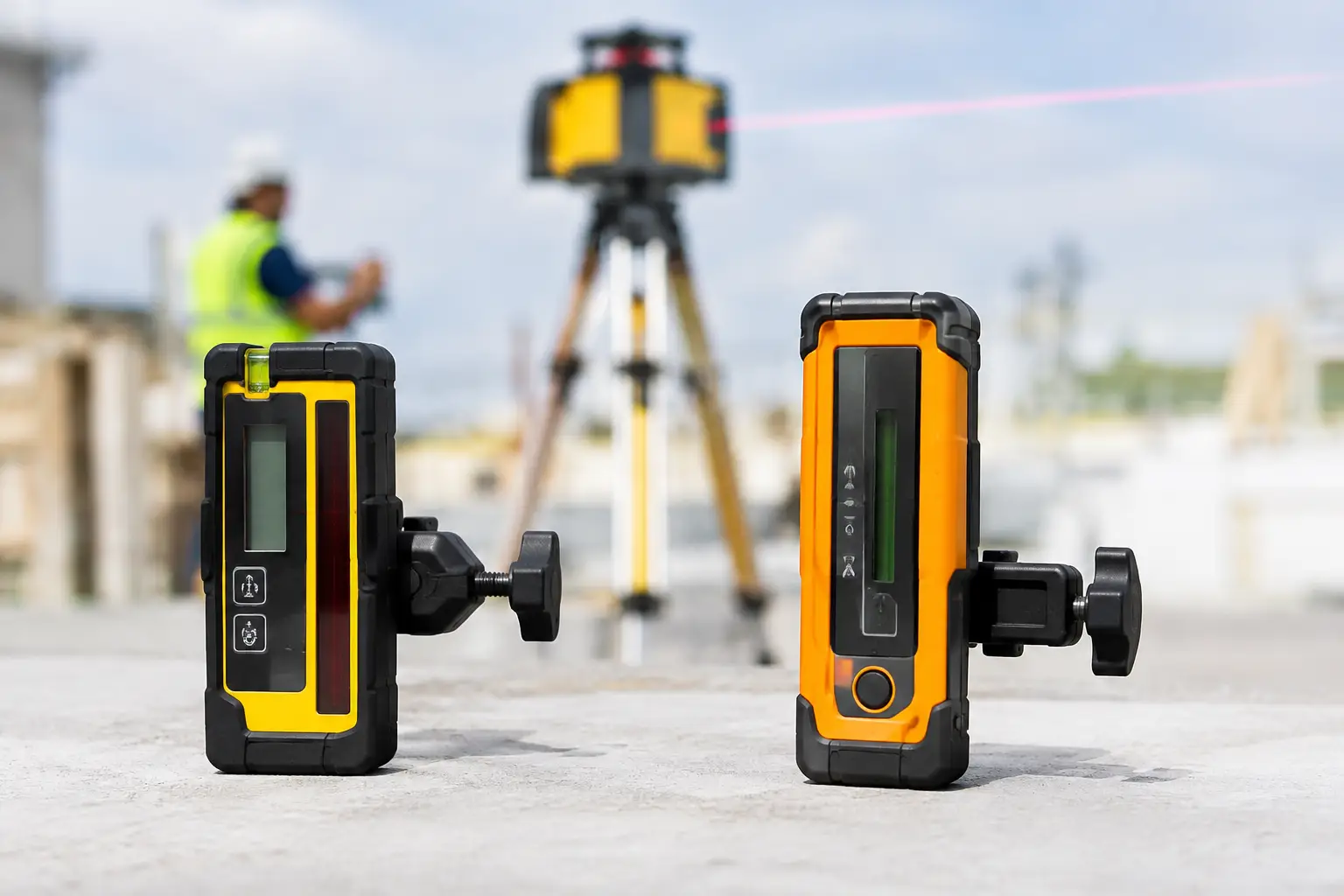
In direct sunlight, the laser line itself often tells you nothing. A rotating laser may work properly, be precisely adjusted and calibrated, but you simply won't see the beam at a distance of tens of meters. That's why choosing a receiver for outdoor work is as important as choosing the laser itself. The receiver will determine whether you will spend minutes searching for the height, or find it with the first movement of the staff.
For earthworks, formwork, concreting, building foundations or installing sewers, the receiver is not an extra accessory. It is the working part of the entire set. If it does not fit the type, accuracy or compatibility with the laser, even a high-quality tripod or long leveling staff will not help.
Why is a visible beam not enough outdoors?
The red beam is visible outdoors, especially at shorter distances, in cloudy skies or in the shade. The green beam is perceived more clearly by the human eye, but even that is no substitute for a receiver in bright sunlight. In addition, with a rotating laser, you do not see the beam as a continuous line, but as a rapidly rotating point that the receiver captures with its sensing window.
The receiver will then indicate via sound, LEDs or display whether the bar needs to be moved up, down or if you are exactly level. In practice, this is the difference between quickly transferring height on the dig and constantly searching for a weak beam with your eyes.
It is important not to look only at the declared range of the laser. Manufacturers often specify the working diameter with the receiver. A laser with a range of, for example, 500 or 600 meters will only work at that distance if the receiver can correctly capture its rotating beam.
Conventional or digital receiver?
A basic receiver is suitable where you need to get the batten level or roughly set the height. It usually has several LEDs, an audible signal and a center mark. When you get level, a continuous tone sounds or the center LED lights up. For concreting a slab, installing curbs, preparing formwork or checking an excavation, this is in many cases a completely sufficient solution.
The digital receiver goes further. It not only indicates whether you are above or below the level, but also shows the deviation in millimeters on the display. For example, the worker knows that he has to move the staff down by 8 mm, not just search indefinitely for the center between the diodes. For precise installations, sewers, checking the heights of underlying layers or repeatedly transferring dimensions on a larger construction site, the digital reading is quickly returned in time saved.
However, the digital version is not automatically necessary for everyone. If you are doing mostly rough landscaping and the tolerance is in centimeters, a regular receiver is a sensible and more cost-effective choice. If you are passing on precise heights to another construction team or working with detail, the millimeter reading has a clear meaning.
Tolerance width determines both speed and accuracy
Each receiver works with a certain accuracy of capture. With a wider tolerance, it signals the plane earlier, so it works faster in excavations and rough work. With a narrow tolerance, it responds more accurately, but requires more leisurely staff adjustment and more patience.
It is ideal if the receiver allows switching between fine and coarse modes. At the beginning, you can quickly find the height in coarse mode, then switch to fine and adjust the exact value. This is not a showcase function. When working all day on a construction site, it reduces the number of repeated measurements and the risk that the worker will be satisfied with an approximate position.
Compatibility: laser first, receiver second
The most common mistake when buying is assuming that every receiver works with every rotary laser. This may not be the case. The receiver must be able to recognize the frequency and rotation pattern of a particular laser. For some brands, a universal receiver may work, for others, a model designed specifically for the device is required.
Before ordering, please verify the laser type, beam color, and supported receiver. Red and green lasers may not use the same sensor. Also, not every receiver will work with a laser that has a special mode for working with inclination or a higher rotation speed.
If you already own a laser, it is not enough to send information that it is a "rotary level". The manufacturer, model designation and, ideally, a photo of the product label are decisive. This way, you can avoid buying a part that looks right, but does not capture a single impulse on the construction site.
Rotary Lasers - Levels have the advantage of their own sets in that the receiver, laser and holder are matched to work together. When choosing separate accessories, it makes sense to check compatibility in advance. It is cheaper than dealing with replacement after the concreting is about to begin.
A batten holder is no small thing
Even an accurate digital receiver measures poorly when it moves on the staff or is turned out of the direction of the beam. A solid holder should hold the receiver without play and allow for quick adjustment on the leveling staff. When working in pairs, the worker with the staff often changes the height of the receiver several times a day, so clamping should be easy even with gloves.
Check what width of batten the mount is designed for and whether it is included in the package. Some cheap receivers are sold without a quality mount or with a universal solution that does not hold firmly enough on a wide batten. In wind, mud and frequent carrying, this difference is immediately noticeable.
When setting up, there is a simple rule: the receiver must be placed flat on the staff and the detection window should be facing the laser. The staff must be vertical. If it is tilted, the height error does not come from the laser or the receiver, but from the operator.
Range, sound and display in real work
Consider the receiver range based on the longest normal distance on your jobs, not the once-a-year exceptional situation. For single-family homes, foundation slabs, and routine installations, the standard working range of the set is usually sufficient. For large halls, long roads, extensive excavations, or landscaping, a laser and receiver with a longer range is worthwhile.
Sound signaling is especially practical when the worker is watching the batten and cannot constantly look at the display. In a noisy environment, a louder speaker or the ability to turn off the sound and work according to the diodes will help. A weak whistle is not useful when working with machines, a vibrating plate or a busy road.
You will appreciate the display on a digital model, ideally on both the front and back. When working with a staff, the receiver often rotates depending on which side the operator is standing. If the reading is only on one side, you are unnecessarily manipulating the staff or leaning around it. The backlight will help in the dark, in the garage or when working early in the morning.
Endurance and power will decide the season
A receiver designed for construction sites must be able to handle dust, occasional rain, and normal drops during handling. IP54 protection is a reasonable basis for work equipment, but it does not mean that you can leave the device in a puddle all day or wash it with pressure water. After work, it is better to wipe the sensing window, check the holder, and store the receiver in its case.
Battery power is easy, as you can buy replacement batteries almost anywhere. A rechargeable battery is convenient for everyday use, but you have to think about charging it. If you are working outside the workshop or in the field without electricity, always have a spare power supply ready. A receiver that runs out while transferring the last dimension can stop the whole party.
Also pay attention to the availability of a spare holder, battery cover, charger or service. The receiver is a more consumable work accessory than the laser - it is often carried, clamped to a staff and the operator works with it in dirt. The option of repairing or buying a part is therefore more advantageous than buying a whole new piece every time it is damaged.
Choosing a receiver for outdoor work according to the type of job
For regular construction work, a rotary laser set with a classic external receiver, holder and batten is a good choice. You get fast plane determination, good readability in sunlight and easy operation for every construction worker.
For precise work at height, sewers, steel construction installation or checking subgrade layers, choose a digital receiver with millimeter readings and fine tolerance options. However, you will only benefit from the accuracy if you have the laser correctly adjusted and regularly checked.
When working with slopes, it is important to distinguish between the receiver and the laser function. The digital receiver displays the deviation from the plane or set reference, but the slope itself in the X or Y axis is set by the slope rotating laser. Therefore, for sewer trenches, drainages and terrain with a slope, consider the entire system, not just the sensor.
The right receiver shouldn't be the most expensive or the cheapest. It should respond to your laser, sit firmly on the staff, be readable in the conditions of your work, and handle the accuracy that the job really requires. When you clarify these four things before buying, you won't be looking for a beam on the construction site - you'll be measuring straight away.