The excavation should be a few centimeters deeper, the formwork must sit at the same height and the concreting is already waiting. At that moment, the construction laser decides whether you will measure quickly and accurately, or whether you will constantly transfer the height with a hose level and correct errors. A good rotating laser is not an addition to the suitcase. When working regularly in the field, it is a device that saves the whole party time.
What is a construction laser used for in practice?
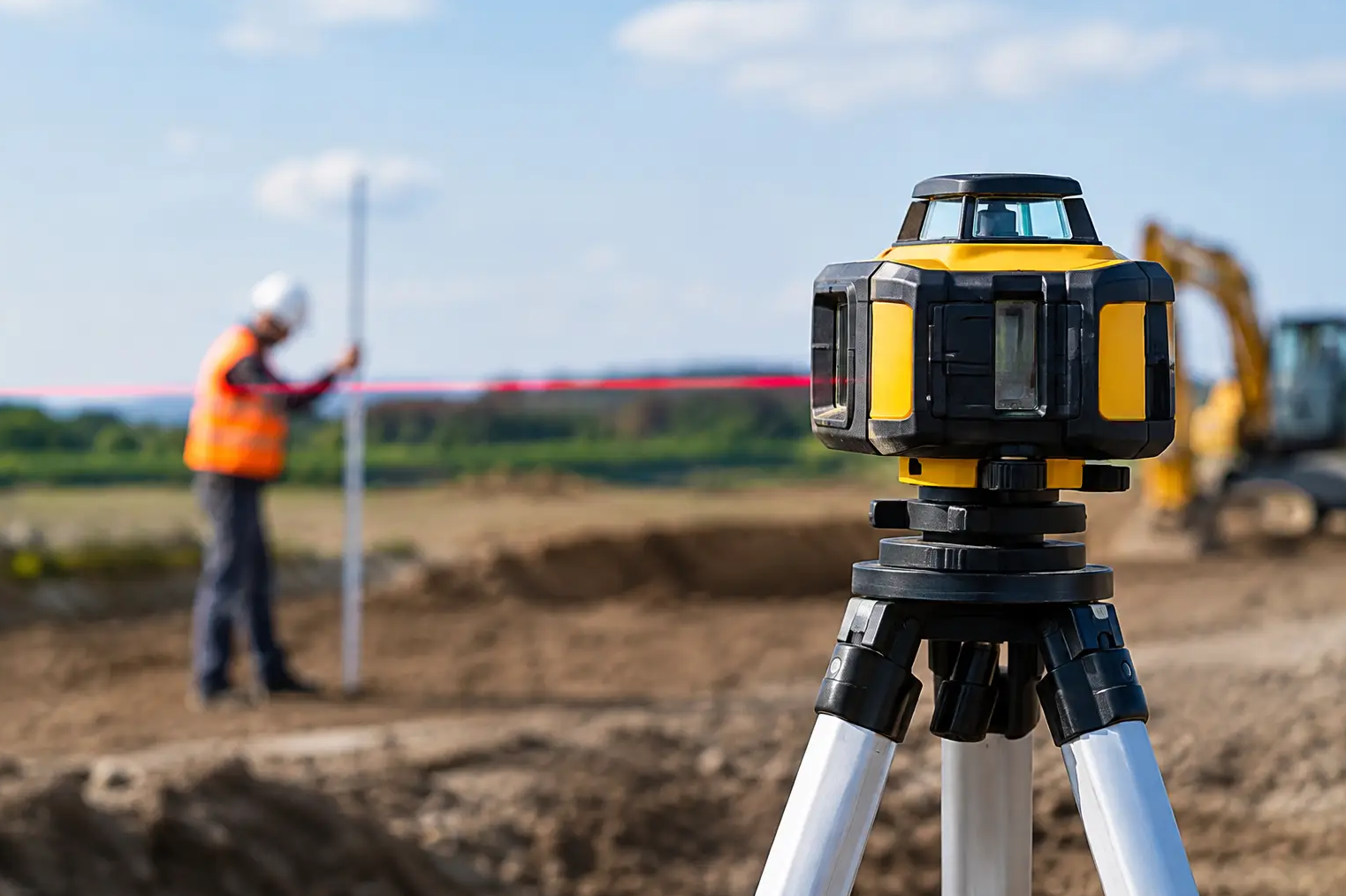
The rotating laser creates a horizontal plane in the entire work area. After being placed on a tripod, it levels itself within its self-leveling range and, by rotating its head, sends a laser beam up to 360 degrees. The receiver on the staff then shows whether the point is too high, too low or exactly in the desired plane.
On construction sites, it is used to establish the height of foundations, check the bottom of the excavation, install formwork, measure heights during concreting, and transfer levels across the property. Indoors, it will help with suspended ceilings, installing partitions, installing windows, wiring, or laying floors. Outdoors, it is of great importance for landscaping, driveways, drainage, and sewerage.
The difference compared to manual measurement is not only in convenience. The laser keeps the plane level at all times. When one person has a tripod, laser, receiver and staff, the second worker can immediately read off heights at multiple points. This eliminates a lot of unnecessary moving and arguing on a larger construction site.
Red or green beam?
The color of the beam is often a consideration when choosing. A green beam is more visible to the human eye, especially indoors or in a shaded area. It can be more comfortable for installations where the worker is watching the beam directly on the wall. However, this does not mean that a green laser automatically measures more accurately. Accuracy is determined by the design of the device, its calibration and proper use.
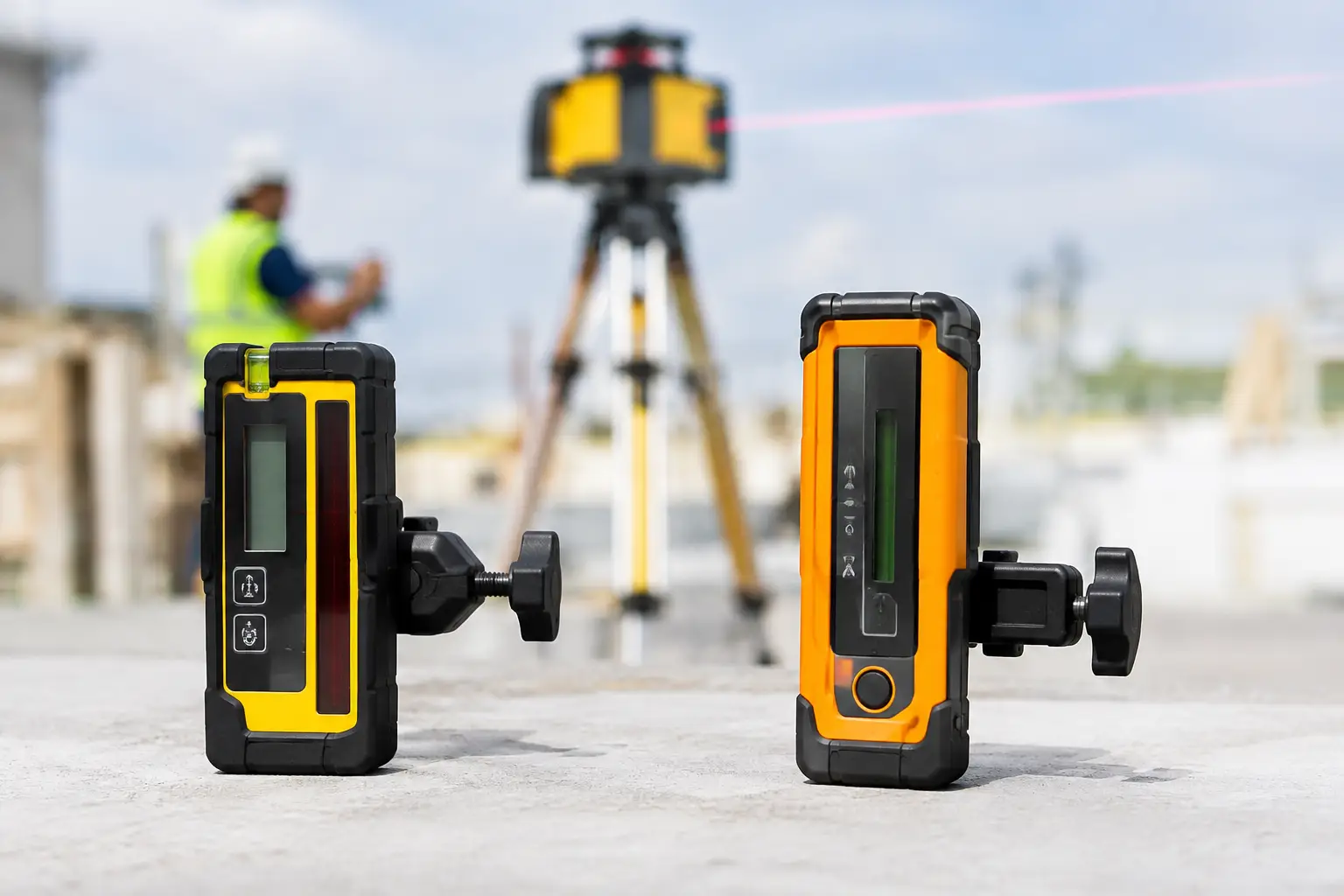
In direct sunlight, even a strong green beam is not reliably visible to the naked eye. The external receiver is decisive here. The receiver captures the rotating beam even at a greater distance and guides the worker to the correct height using sound or a display. For excavations, foundation slabs and field work, the receiver is therefore practically a mandatory part of the set, not an optional accessory.
The red rotating laser still has its place. It is affordable, reliable, and when used with a receiver, it provides the same measurement principle as the green model. If you work mostly outdoors, it makes more sense to invest in a quality receiver, a sturdy tripod, and a staff than to pay extra just for the color of the beam.
Conventional receiver and digital readout
The basic receiver shows the position relative to the laser plane with arrows, LEDs or an audible signal. It is fully sufficient for normal leveling. The worker moves the receiver along the staff until a continuous tone is heard or the center position is displayed.
The digital receiver goes further. It can display the deviation in millimeters, for example, that the measured point is 18 mm above the plane or 32 mm below it. This is useful for more precise concreting, inspection of finished surfaces, height setting and for work where you need to make decisions without repeated fine-tuning. This does not mean that every tradesman needs a digital sensor. However, if you deal with heights on a daily basis and centimeter orientation is not enough, you will feel the difference in the speed of work very quickly.
When choosing, always compare the width of the detection band. A finer setting will allow for more precise targeting, but may require more sensitive work with the staff. A coarser setting is faster for rough earthwork. It is ideal if the receiver offers several degrees of accuracy depending on the type of task.
When do you need a grade construction laser?
A standard rotating laser creates a horizontal plane. This is the right solution for foundations, formwork, flat surfaces or transferring a single height. However, if you need to create a specific slope, for example for a sewer connection, drainage, road or paved area, you need a digital slope model .
The digital rotating laser allows you to set the slope in the X and Y axes. In practice, this means that the plane does not have to remain horizontal, but can have a precisely specified slope in one or two directions. This way, you do not work by eye or with improvised marks when laying pipes. You set the desired value, the laser holds the defined plane and the receiver checks the individual points of the route.
It is not worth choosing only based on the lowest price. Slope work has consequences - incorrect sewer slope or poorly sloped area means rework. It is important to have a legible display, stable settings, a suitable range of slopes and the ability to check the device before work. For such orders, it is also wise to use personal training so that you know the setup procedure and check the measured values.
Accuracy, range and coverage: parameters to read
With rotary lasers, the only thing that is often considered is the range. A longer range is an advantage, but only if it corresponds to your real work. For a family house and regular installations, you do not need parameters designed for extensive communications. However, on a large plot of land, near a hall or a longer sewer line, a quality receiver and a sufficient working diameter are essential.
Measurement accuracy is usually stated in millimeters over a certain distance. A smaller number means a more accurate instrument, but a distinction must be made between the requirements for foundation work and those for fine installation. For rough earthworks, durability, range and quick operation may be more important. For floor leveling or installing precision elements, precision readings and verified calibration are crucial.
The construction environment also includes protection against dust and splashing water, often IP54. Such protection can handle normal work in dusty environments and light rain, but not submerging in water or carelessly leaving the device in a downpour. Also monitor the operating temperature, the type of power supply and the availability of a spare battery or charger. A laser that runs out in the middle of concreting is a problem regardless of its paper parameters.
A kit that works outside the warehouse
A laser alone without accessories often does not produce the expected effect. For field work, a work set with a tripod, receiver, receiver holder and 5-meter staff is worth it. The tripod must stand firmly, because even a small displacement of its legs will change the entire measured plane. It should be checked regularly on soft or wet ground.
Before you buy, be clear about four things:
- whether you will be measuring mainly indoors, outdoors, or both,
- whether you need only a horizontal plane or also a controlled slope,
- what precision and distance your orders require,
- whether you have a quality batten, a stable tripod and a suitable receiver.
Accessories are no small matter. A damaged mount, an unreadable staff, or an inaccurate receiver can ruin even a good laser. That's why it makes sense to buy a system that has parts, chargers, mounts, and service available. In everyday use, serviceability is often more valuable than a cheap device without support.
Calibration is not a formality
A rotating laser is a measuring instrument. It has been driven over in a car boot, hit while loading or fallen off a tripod - and its plane can shift. The deviation may not be visible at first glance, but when transferring heights of tens of meters it can grow into an unpleasant error.
Before starting an important job, it is worth doing a simple check. Place the laser between two points, measure the height on one side, rotate or move the device according to the check procedure and compare the results. If the values do not match within the declared tolerance, the device needs to be calibrated . It is not good to "correct it in your head", because when you take further measurements you will no longer know where the error occurred.
At Rotary Lasers - Levels, new devices are calibrated before sale, which is a particular advantage for work tools. Equally important is the possibility of warranty and post-warranty service and repair, when the device needs to be returned to accurate values after the season or after a fall.
Choose by job, not by suitcase color
For most construction projects, a self-leveling rotating laser with an external receiver, staff and tripod is the right foundation. The green beam makes sense where you often follow the beam directly. You will appreciate the digital receiver for more precise height setting. The slope model is designed for people who regularly make slopes, not for every one-off measurement.
The best decision is made when you name your most frequent job before buying: foundation slab, excavation, sewerage, assembly or terrain. Then the technique is chosen simply - according to what will save you from measuring, repairs and unnecessary lost time on this job every week.