When concreting a foundation slab, a few millimeters are often decisive. In the case of sewage, the same deviation can mean a bad slope, and when installing a ceiling, unnecessary underpinning and alterations. Construction leveling is not a paper check at the end of the work. It is a procedure that maintains the correct height, plane, direction or slope during construction.
A rotating laser will make this job much faster. Instead of transferring heights with a hose level, stretching cords and repeatedly measuring with a tape measure, it creates a reference plane for the entire work area. When the device is correctly set up, calibrated and you use a suitable receiver, you have height under control even over tens of meters.
What does construction leveling solve in practice?
Leveling means determining the height differences between points and transferring the desired height to the terrain or structure. Construction is not just about whether something is “level.” You often need to know how much one point is higher or lower than another and whether the work is following the designed elevation.
When digging foundations, the depth and level of the bottom are checked. When forming, the height of the upper edge of the concrete is transferred. When laying bricks, the first row is established, when installing plasterboard, the height of the grid, when installing windows, the installation of window sills, and when landscaping, the final profile of the surface. In sewers, drainage or gutters, a horizontal plane is no longer enough - a controlled slope is decisive.
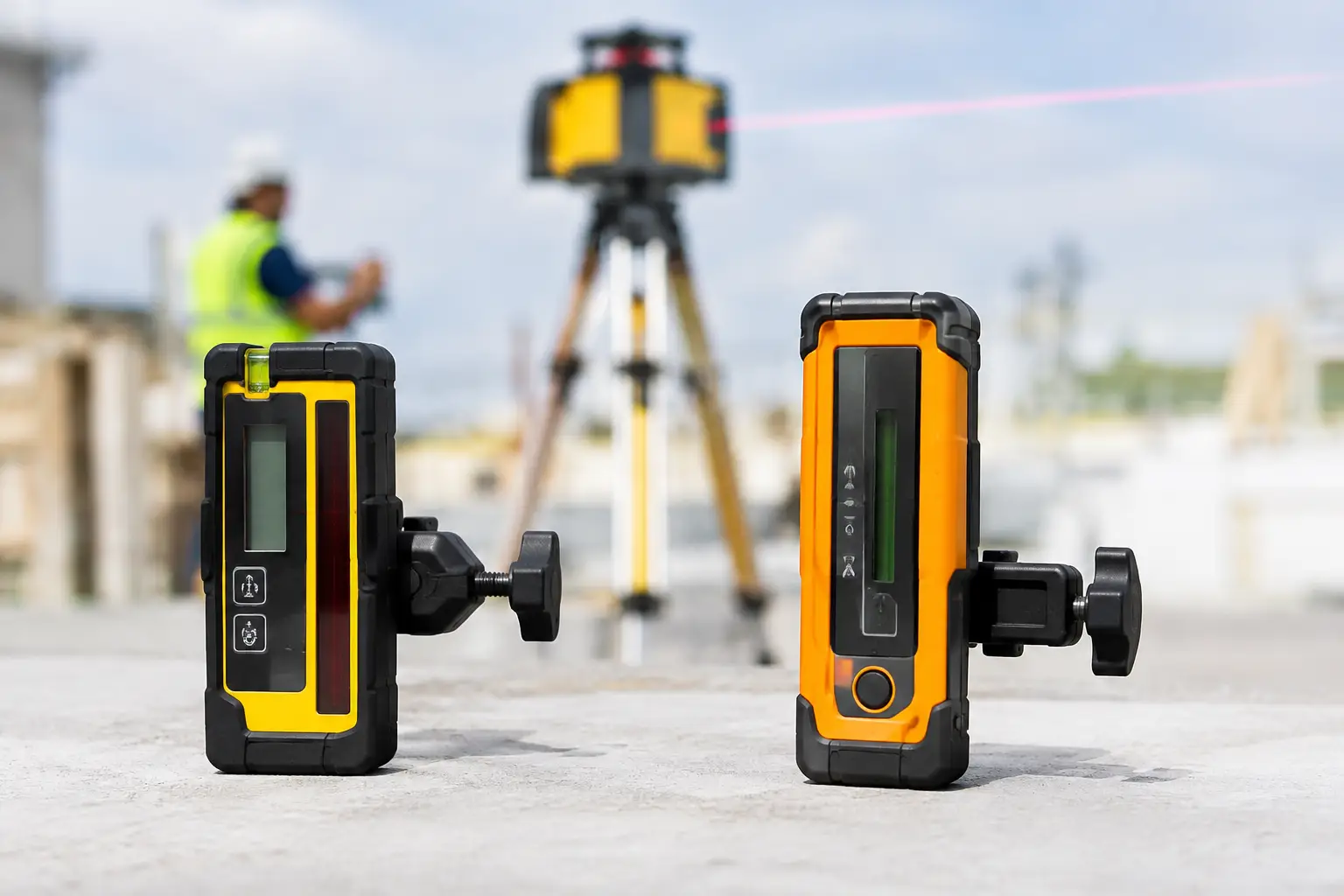
The rotating laser creates a horizontal laser plane in a range of 360 degrees when turned on. The receiver on the staff captures the beam even where it is not visible to the naked eye. In the sun, an external receiver is practically indispensable. The color of the beam can improve visibility when working indoors, but the outdoor range is mainly determined by the quality of the receiver, the laser power and the correct setting of the workplace.
Construction leveling with a rotating laser step by step
Most errors are not caused by measurement, but by preparation. The laser must be placed in a fixed position, have a clear view of the work area, and not be exposed to mechanical shocks. If you place it on soft ground next to the excavation, the result may be inaccurate even with a quality device.
1. Determine your reference point
Start with a point from which you will derive everything. This could be a surveyor's elevation mark, a finished floor, the top of a curb, or a firmly marked point on the site. Protect the reference point from damage. If you lose it during the work, the entire subsequent measurement can turn into an estimate.
Place the rotating laser on a tripod or stable surface and allow it to complete self-leveling. A typical automatic model will compensate for minor tripod misalignments on its own, but it is no substitute for proper positioning. First, set the tripod approximately level, press the legs firmly into the surface, and check that it is stable.
2. Set the zero on the staff
Mount the receiver on a leveling staff. Place the staff exactly on the reference point, move the receiver up or down and find the center signal. When the receiver shows the center, mark its position or read the value on the staff.
This height represents your working zero. For other points, you simply compare the reading with the reference. If the receiver is lower at the center signal, the point in the terrain is higher. If it needs to be higher, the terrain or structure is lower. With a digital receiver, you get the difference directly in millimeters, which speeds up leveling of the base and formwork.
3. Always measure with a vertical batten
The battens must be vertical. Even a slight tilt can add an error, which is not negligible when working over a greater distance or when pouring concrete precisely. A spirit level on the batten helps, but when working in soft terrain, you should also check to see if the bottom of the batten has sunk.
When transferring height to a wall or pole, use a suitable receiver mount and a fixed measurement point. When checking multiple locations, note the differences in measurement. Do not base your decision on one random check, especially if an excavator has been moving around the job site or the tripod has been moved.
Planes, heights and gradients are not the same thing
The standard self-leveling rotating laser creates a horizontal plane. It is the right choice for foundations, floors, formwork, assembly work, height markings and most general marking out. It is fast, easy to operate and, when used correctly, will provide the accuracy needed for both trades and construction practices.
However, if you need to consciously create a slope, for example for a pipeline, access road, parking lot, drainage or drainage, you need a slope or digital rotation laser . Such a model allows you to set the slope in the X axis, in the Y axis or in both axes. The device then does not create a horizon, but a precisely defined inclined plane.
It is not worth improvising here by manually tilting a conventional laser . With some devices, a warning is activated or accuracy is lost completely after the self-leveling range is exceeded. Digital slope adjustment is more expensive, but it saves time, material and complaints in repeated field and sewer work.
When to choose a red, green or digital model
A red rotating laser is a sensible and cost-effective choice for most outdoor work with a receiver. When working on earthworks, foundations or concreting, you don't rely on seeing the beam with your eyes - the receiver on the staff is the deciding factor. That's why a quality work set with a staff, tripod and reliable receiver is often more worthwhile than a laser with a more distinctive beam color.
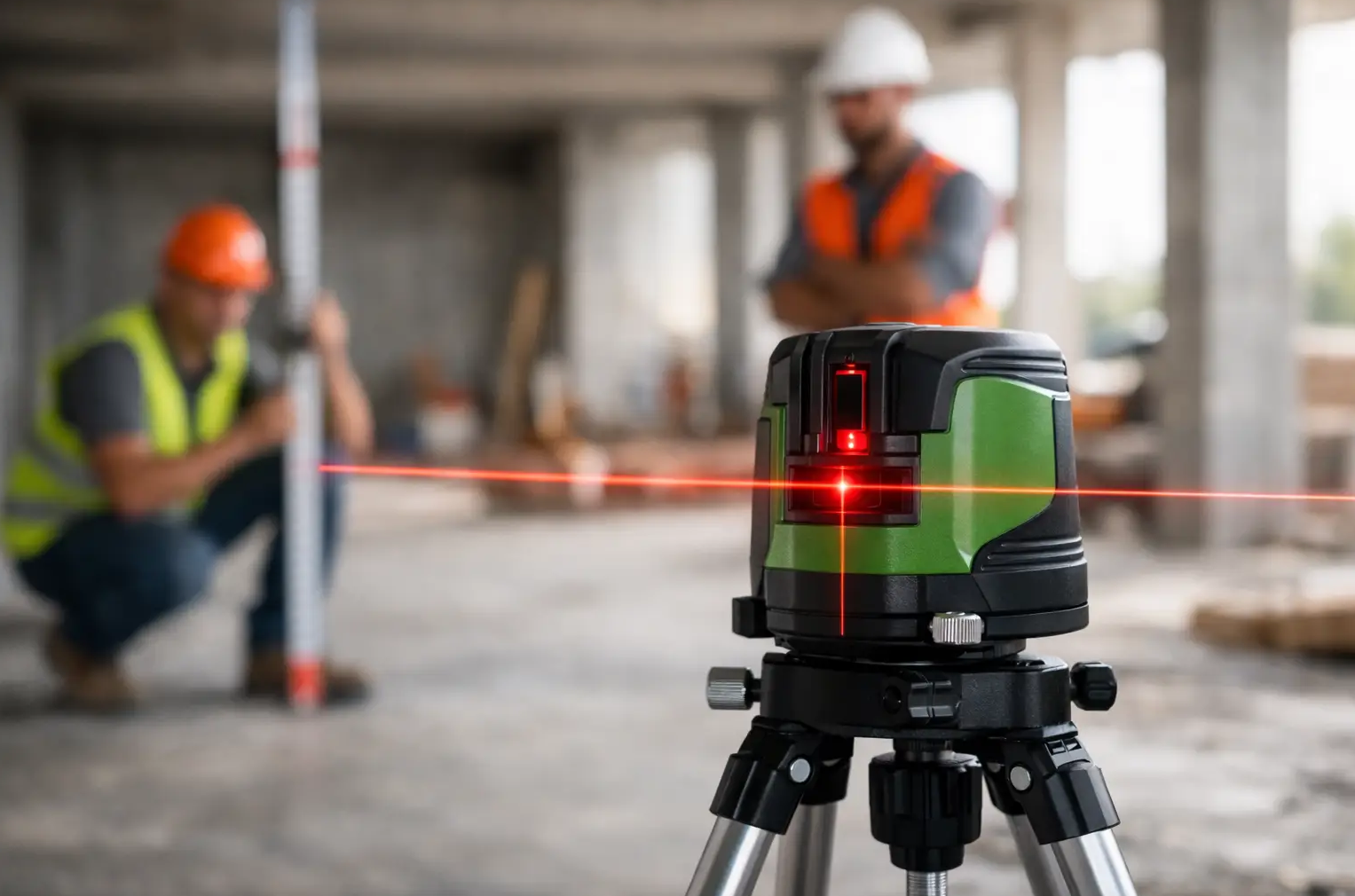
The green beam is better visible indoors and in the shade, which is useful when installing partitions, ceilings, tiles or when marking heights in halls. However, outside in bright sunlight, even the green color will not solve the task without a receiver. It has an advantage when the worker needs to continuously see the line directly on the surface.
A digital receiver with a millimeter readout makes sense for precise leveling. Instead of just saying "a little up" or "a little down," it will show the actual deviation. When pouring a slab, laying curbs, or adjusting slopes, this information is much more useful than just an audible signal.
Mistakes that unnecessarily spoil the result
The most common problem is a laser without a calibration check. The device can light up, self-level and still measure outside the tolerance. After a fall, transportation in a loose case or prolonged intensive use, it is worth checking the accuracy. A pre-calibrated device before sale gives a better start, but regular checks are part of responsible work.
The second error is the wrong receiver mode. If the receiver does not respond stably, first check the batteries, compatibility with the rotating laser, the sensitivity of the receiver and whether the laser is actually rotating. On some models, the scanning mode or reduced speed may be turned on, which changes the measurement behavior.
Also, be careful when moving the tripod. When you move the laser, you have to re-establish the reference. Continuing with the old reading is an error that can easily be carried over throughout the entire construction. For long work sections, it is worth checking the control point continuously to see immediately if the assembly has moved.
Choosing a kit based on real work
For a company that mainly does foundations, slabs, excavations and general assembly, an automatic rotating laser with a receiver, 5-meter staff and tripod is practical. The complete set means that you can actually measure after delivery, rather than buying basic accessories piecemeal.
If you regularly work indoors, the green model will bring better comfort when visually checking the beam. If you do sewers, communications or terrain modeling with specified percentages, look for a digital slope model. When choosing, pay attention to accuracy, working range with the receiver, at least IP54 protection, self-leveling range, power supply and availability of service and spare parts.
At Rotary Lasers - Levels, the devices are delivered calibrated and can be personally tested and consulted in Švábovce near Poprad. This is of practical value especially when you are not sure whether you need a regular horizontal laser or a solution for precise inclinations.
A good level won't replace a project or an experienced worker, but it will take the guesswork out of a job where guesswork costs money. Before you start pouring concrete, digging, or installing pipes, have a solid reference point, a stable tripod, and the right receiver ready. Then every subsequent height will be a matter of measurement, not estimation.