When building a house, pouring concrete or digging a sewer, millimeters are often decisive. A self-leveling rotating construction laser will give you a common height plane for the whole team without constantly carrying a hose level and without guessing. The right device saves time with every measurement, but only when it is chosen according to the real work, not the lowest price or the color of the beam.
How a self-leveling rotating construction laser works
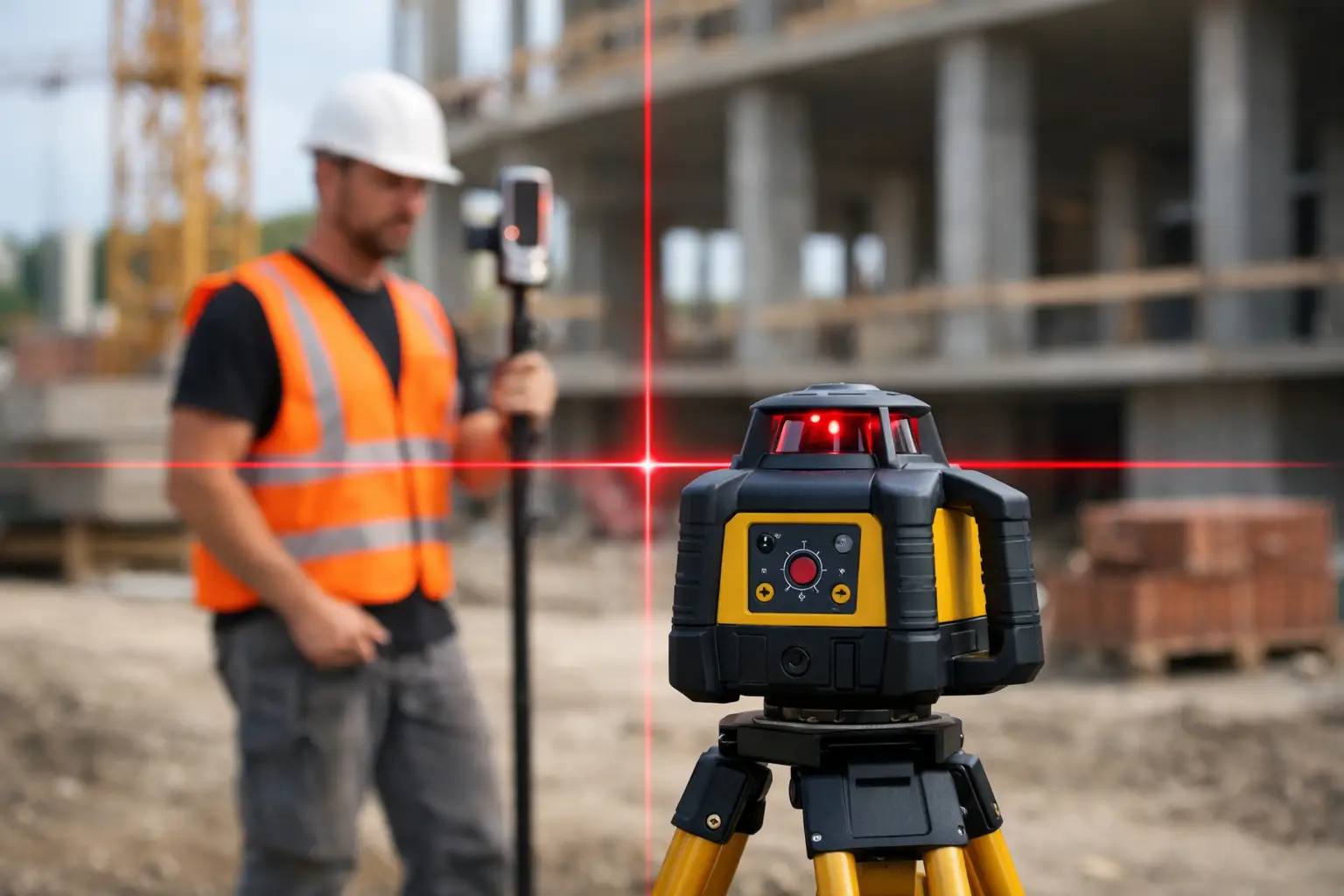
The rotating laser creates a horizontal plane within a range of 360 degrees after the laser head is rotated. You place it on a tripod or a solid surface, turn it on, and the compensator will automatically compensate for the slight tilt of the device. In common models, the self-leveling range is approximately ±5 degrees. When the device is outside this range, it warns of an error or stops so that you do not work with the wrong height.
It is the automatic leveling that distinguishes a rotating laser from a simple cross-line laser. A cross-line laser is excellent indoors for tiling, partitions or assembling furniture. However, on an open construction site, you need to see or capture the height even tens of meters from the device, from all sides and often in direct sunlight. This is where a rotating laser with an external receiver and staff comes in.
A laser level alone won't solve everything. You have to determine the correct design height, transfer it to the batten, and check as you work that the receiver is pointing to the center. Once you have set the base point, further checks are quick - for formwork, gravel bed, curbs, and final concrete, everyone works according to one reference.
When is a standard model enough and when is a digital model needed?
For most height work, an automatic self-leveling model for a horizontal plane is sufficient. You can use it when laying foundations, leveling the base, concreting foundations and slabs, installing ceilings, installing windows, landscaping or checking the height of curbs. It is important that it works with a receiver, has sufficient range and is delivered calibrated.
A digital rotating laser is useful where you regularly adjust the slope. A typical example is a sewer, drainage, sidewalk, gutter, parking lot or terrain from which water must flow in the right direction. A model with slope adjustment in the X and Y axes will allow you to enter the desired slope directly into the device. You then do not have to create the slope by placing the laser or tedious counting on a staff.
The digital version costs more, so it is not worth it for everyone. If you do a slope once a year on your own order, a regular rotary laser, a correctly selected reference point and a calculation of the height difference are often enough. However, if you carry out sewers, paved areas or terrain modeling regularly, setting the slope in percentages or per mile will pay off in speed and with less risk of error.
The receiver is not an extra accessory
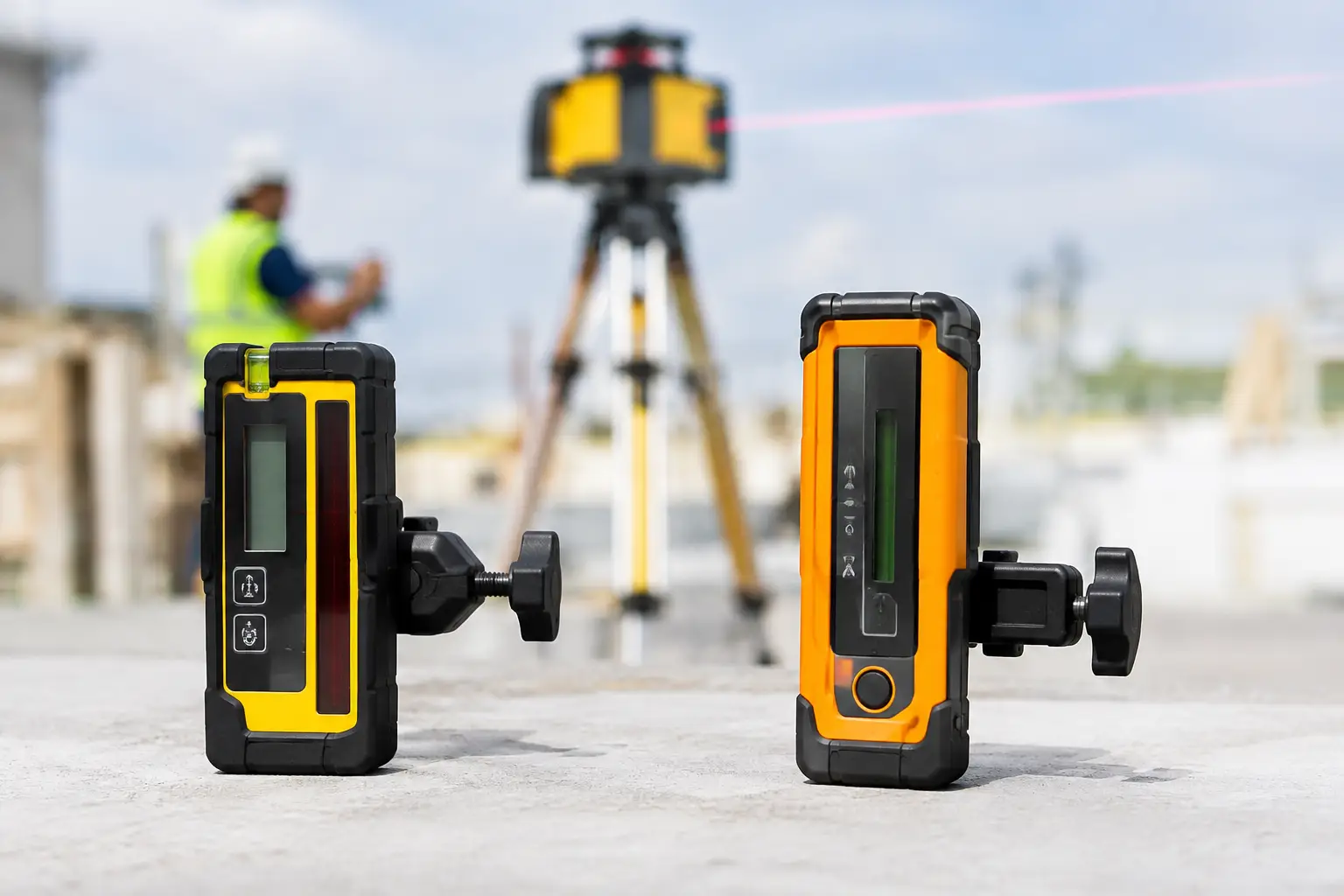
In the sun, both the red and green beams are practically invisible at a greater distance. An external receiver is therefore not an accessory worth saving on, but the basis of your work kit. It is attached to the leveling staff and shows you with sound and a display whether you are above, below or exactly in the middle of the plane.
A regular receiver is suitable for quick centering. A digital sensor with millimeter readings also displays the specific deviation from the laser plane. This is practical for fine-tuning formwork, checking heights before concreting, or work where you don't just want to know that you are off, but by how many millimeters.
When purchasing, check the compatibility of the receiver with the laser. Not every sensor works with every rotary laser, and the difference may also be in the range, sensitivity or digital readout function. A complete set with receiver, staff and tripod is usually the safest way for a new user, because the individual parts are matched to work together.
Red or green beam?
The green beam is perceived more clearly than the red beam, especially indoors, in the shade and at shorter distances. It is more pleasant for assembly, when working in a hall or when you need to see the laser line directly on the structure. However, this does not mean that a green rotating laser will replace a receiver in an open area.
When it comes to outdoor leveling, the quality of the receiver, the accuracy of the device, the stability of the tripod and the correct setting of the workplace are more important. A red rotating laser with a quality receiver can handle common construction work reliably even on a clear day. The green model makes sense if you combine outdoor measurement with frequent indoor work, where better beam visibility will really speed up assembly.
Don't just choose a color based on your impression. If the laser will be standing at the excavation most of the time and measuring with the receiver, the color of the beam is not the main parameter. If you will be using it daily for indoor installations, a green beam may be a more comfortable choice.
Parameters that have real significance in construction
The accuracy of a rotary laser is given, for example, in millimeters per 10 meters. When doing foundation and field work, it is important to know that the result is not created by the device itself. The deviation also depends on the position of the staff, the stability of the tripod, the correct reading of the receiver and the distance. When working on sensitive work, it is wise to continuously check the height from two directions, rather than relying on one reading.
The working range of rotating lasers is often stated with the receiver. Without a receiver, the beam can only be seen from a short distance, while with a receiver you can work over a large area. Therefore, do not confuse the visibility of the beam with the actual working range of the device.
Protection is also important. IP54 is a practical standard for regular construction, as it protects the device from dust and splashing water. This does not mean that you can leave the laser standing in a puddle or use it unprotected in a heavy downpour. After work, clean it, dry it and store it in the case. Dust on the laser or receiver window can impair function more than it seems at first glance.
Pay attention to power and endurance. A rechargeable battery is practical for everyday work, but for longer trips it is worth having a spare battery or charger in the car. With a cheap device without available power or spare parts, the apparent savings can quickly turn into job downtime.
The tripod and staff determine how comfortable the measurement will be.
A tripod is not just a stand. When digging, on gravel or when there are vibrations from machinery, the laser must be stable. A lightweight tripod is easy to carry, but it may be less stable in strong winds or on uneven ground. For field work, choose sturdy legs, reliable clamping and a sufficient height range.
A five-meter leveling staff gives you significantly more margin than a short staff for foundation and earthworks. When checking a deeper excavation, you don't have to constantly move the laser or improvise with attachments. Hold the staff vertically - even a slight tilt at a greater height can create an error that you will only notice when checking the finished surface.
Before using it for the first time, it is worth doing a simple check at a known point. Set up the laser, read the height from several directions and verify that the values match within the tolerance of the device. Such a check does not take much time and will give you confidence that the device is not operating out of accuracy after being transported or dropped.
Why it pays to deal with calibration and service in advance
A rotating laser is a measuring instrument, not a consumable. When it shows an incorrect plane, the error is transmitted to the entire job - to the excavation, concrete, base and slopes. A pre-calibrated instrument ready for work is therefore more valuable than a box that you just unpack and hope everything fits.
When choosing a dealer, ask if they can provide warranty and post-warranty service, calibration and spare parts. A charger, receiver holder, battery, cover or small part can decide whether you finish the job today or wait for a new device. Rotary Lasers - Levels are based on pre-calibrated devices, stock parts and the possibility of personal consultation or training in Švábovce near Poprad.
If you use the laser regularly, protect it in a suitcase when transporting it and check the accuracy after every strong impact. It is not an unnecessary precaution. It is cheaper than correcting the height error after the concrete has hardened or the pipe has been backfilled.
A good rotating laser should work quietly in the background on the construction site: you set it up, set the reference, and the team knows what to do. Choose a model that has a receiver, a stable kit, and a service center. And before the first sharp measurement, always take two minutes to check the height - these are often the ones that save the whole day's work.