Excavation for the foundation slab, formwork heights, installation of a sewer pipe or leveling when concreting - in such work, millimeters and time are decisive. A rotating laser replaces tedious measurements with a hose level, string and constant transfer of heights between points. With the appropriate set, one person can check the level or slope over tens of meters without constantly calling a colleague to measure.
However, there is no one-size-fits-all device for every job. When choosing, it depends on whether you work mainly indoors or in the sun, whether you only need a horizontal plane or you also set the slope, and whether you will measure with the naked eye or with a receiver. The correctly chosen model will speed up the work. The incorrectly chosen one can turn into an unnecessary expense, even if it has good parameters on paper.
How a rotating laser works
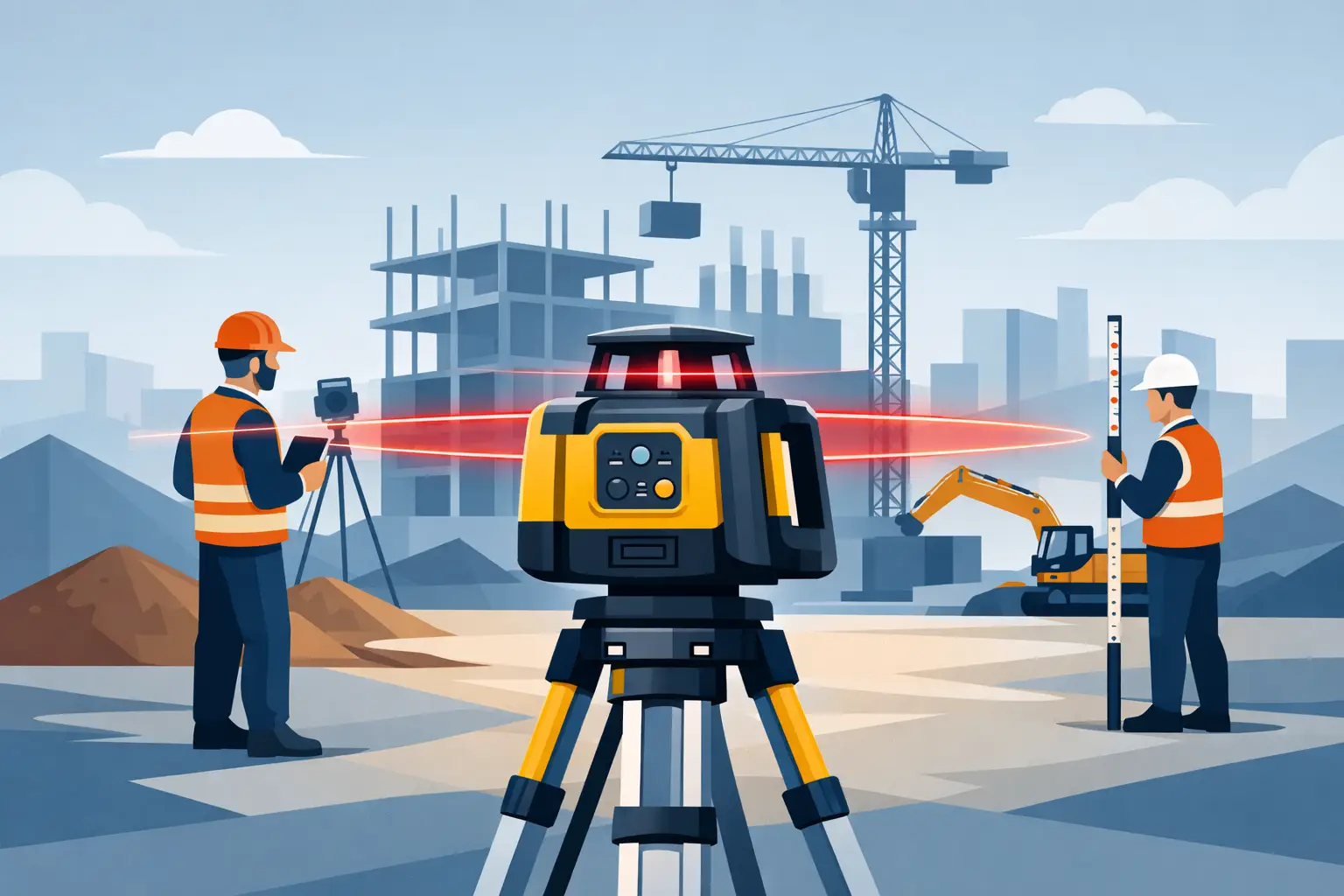
A rotating laser creates a laser plane by rotating the beam through 360 degrees. When placed on a tripod or a solid surface, it automatically self-levels within a specified range, usually a few degrees. The device then finds its own horizontal position and you can mark out the same height throughout the room, around the building or on the ground.
In horizontal work, the laser is used, for example, to check the height of foundations, level the gravel bed, install curbs, prepare the floor or install suspended ceilings. The vertical plane will help when installing partitions, facade elements, columns or structures. Slope digital models add the ability to set the slope in the X and Y axes. This is practical for sewers, drainage, landscaping, parking lots and areas from which water must drain in the right direction.
The accuracy of the laser is stated, for example, in millimeters per 10 meters. The lower the value, the more accurate the measurement. However, it must be read realistically. In ordinary foundation marking or concreting, a difference of a few millimeters is often insignificant, but not so much when installing technology, precise floors or long slopes. Regular inspection and calibration are also important, especially if the device is used every day in a car and on a construction site.
Rotating laser in the sun: you can't do without a receiver
The most common misunderstanding occurs when working outdoors. Even a strong laser beam is only partially visible to the naked eye in direct sunlight. This is not a fault of the device. Sunlight simply has a significantly higher intensity than the laser line.
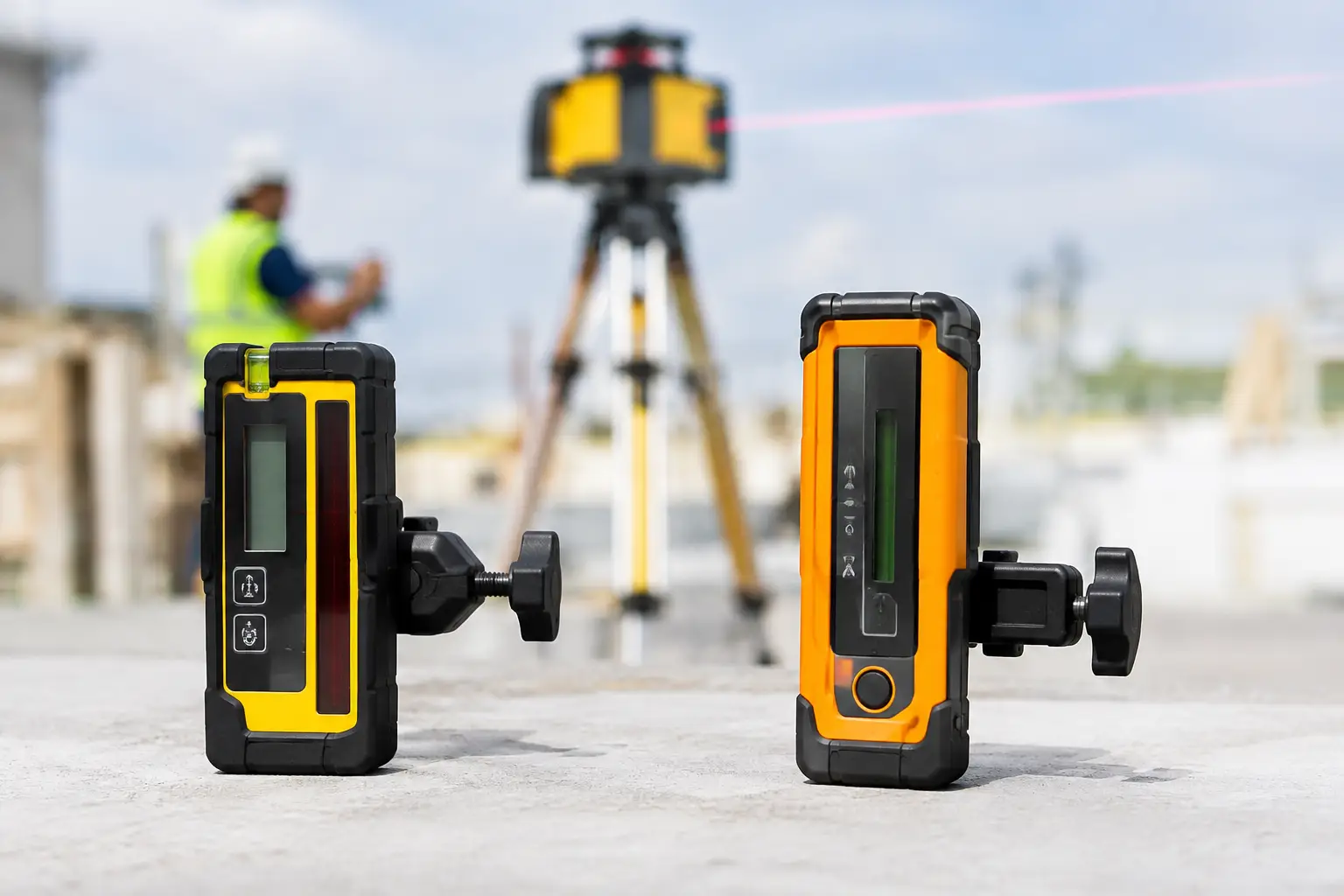
For exterior use, an external receiver, sometimes referred to as a detector, is therefore a basic piece of equipment. You attach the receiver to the leveling staff and move it up or down until the signal shows the exact height of the laser plane. The audible signal allows you to work without constantly looking at the display. This is the fastest way to work when working on earth, building foundations and concreting.
A regular receiver will indicate whether you are above, below or exactly on level ground. A digital receiver will also display the specific deviation in millimeters. This is useful when checking heights, where you don't want to make repeated small corrections by guesswork. A digital sensor is not a necessity for everyone, but it saves time and material when working regularly in the field.
The range listed for rotary lasers usually refers to working with a receiver and is often given as the diameter of the work surface. So when comparing two models, check whether the manufacturer is talking about the diameter or radius. Also, the declared maximum range assumes a clear view, the device is properly positioned, and the batteries are fully charged.
Red or green beam?
A red rotating laser is a proven and cost-effective choice. It works reliably for outdoor work with a receiver, and for most earthmoving and construction work, the quality of the receiver, accuracy and stability of the device are more important than the color of the beam. If you will be measuring outdoors mainly via a staff and a sensor, the red version offers a good price-performance ratio.
The green beam is more visible to the naked eye, so it is advantageous indoors, in halls or during installations where you need to see the plane continuously. It helps, for example, with drywall, tiling, installing wiring or checking heights in poorly lit areas. However, the green beam does not mean that it will be clearly visible even in the bright summer sun without a receiver.
When making a decision, ask yourself a simple question: Will you be measuring more with a staff outdoors, or will you be tracking the beam directly indoors? The first situation favors the red model with a high-quality receiver, the second the green one. If you do both types of jobs, decide based on where most of your work occurs and where accuracy will bring you the greatest savings.
When do you need digital incline adjustment?
The standard self-leveling rotating laser is designed mainly for horizontal and, depending on the model, vertical planes. It is the right and simple choice for normal work at height. However, you cannot set the slope precisely by tilting the device on a tripod. Otherwise, an out-of-range leveling warning will be activated and the measurement will not be reliable.
The digital slope rotating laser allows you to enter the slope separately in the X and Y axes. In practice, this means that you can set, for example, the desired percentage of slope for a pipe or area and then check it with the receiver along the entire route. Both axes are important for areas where water should not drain in only one direction.
It is worth paying extra for a digital model if you regularly do sewers, drainage, paving, driveways or landscaping. If you are setting the grade once a year for one small job, a regular rotary laser and correctly set out heights may be more economical. The choice should be based on real jobs, not on the fact that the device has more functions.
A kit that works on the construction site
The device itself is just the beginning. When working outdoors, a rotating laser requires a stable tripod, receiver, receiver holder and leveling staff. Without a staff, heights in excavations or aggregates are checked inaccurately and unnecessarily slowly. A five-meter telescopic staff is practical for most construction sites, but for deeper excavations or when working from a higher position, check the necessary margin.
The tripod does not have to be the most expensive, but it must hold. A light tripod on a paved floor will serve well, in soft terrain and wind it needs stable legs and a firm grip. Do not move it during the measurement, do not kick it in the legs and always check the reference point after moving it. It is the error in setting up the tripod that is more common in the field than the error of the laser itself.
Also check the power supply. A rechargeable battery is convenient for regular work, but for long jobs it is wise to have a charger or backup power supply. IP54 protection is suitable for regular construction, where the device will encounter dust and occasional moisture, but does not mean that you can leave it in the rain or wash it with a jet of water. After work, clean it, dry it and transport it in a case.
Calibration and service are part of accuracy
The laser may continue to shine and self-level after a fall, but that does not mean that it measures accurately. You can also perform a simple check on a construction site: mark the height on the wall, rotate the device 180 degrees and compare the result. If the height changes significantly, the device needs a professional check.
When buying, it is worth choosing a seller who calibrates the device before shipping, keeps accessories and can provide warranty and post-warranty service . Rotary Lasers - Levels has 12 years of experience, delivers the devices calibrated and during a personal visit in Švábovce pri Poprad can show the operation directly on the device. With work tools, an available part or a quick repair is often more valuable than a small difference in the purchase price.
Before taking your first measurement, set a solid control point and don't be pressured into guessing. A well-placed laser, a receiver on the staff, and a few minutes to verify the height can save you hours of repairs, tons of unnecessary material moving, and an unpleasant complaint about the finished job.