When the height at the other end of the slab is off by a few millimeters during concreting, the problem often did not start with the batten or with the reading. The cause may be a device that, after a fall, transport or prolonged work outside the control, shows a horizontal plane with a deviation. Therefore, calibrating a rotating laser is not a formality for the service book. It is a check whether you can rely on the heights, planes and slopes that you realize according to the laser.
In normal marking out partitions, a small deviation may not immediately be decisive. However, in foundations, sewers, base concrete, setting curbs or adjusting the slope, the error is transmitted to the entire length of the work. The laser may look accurate at a short distance, but at 30 or 50 meters the difference will make unnecessary corrections.
What does rotary laser calibration mean?
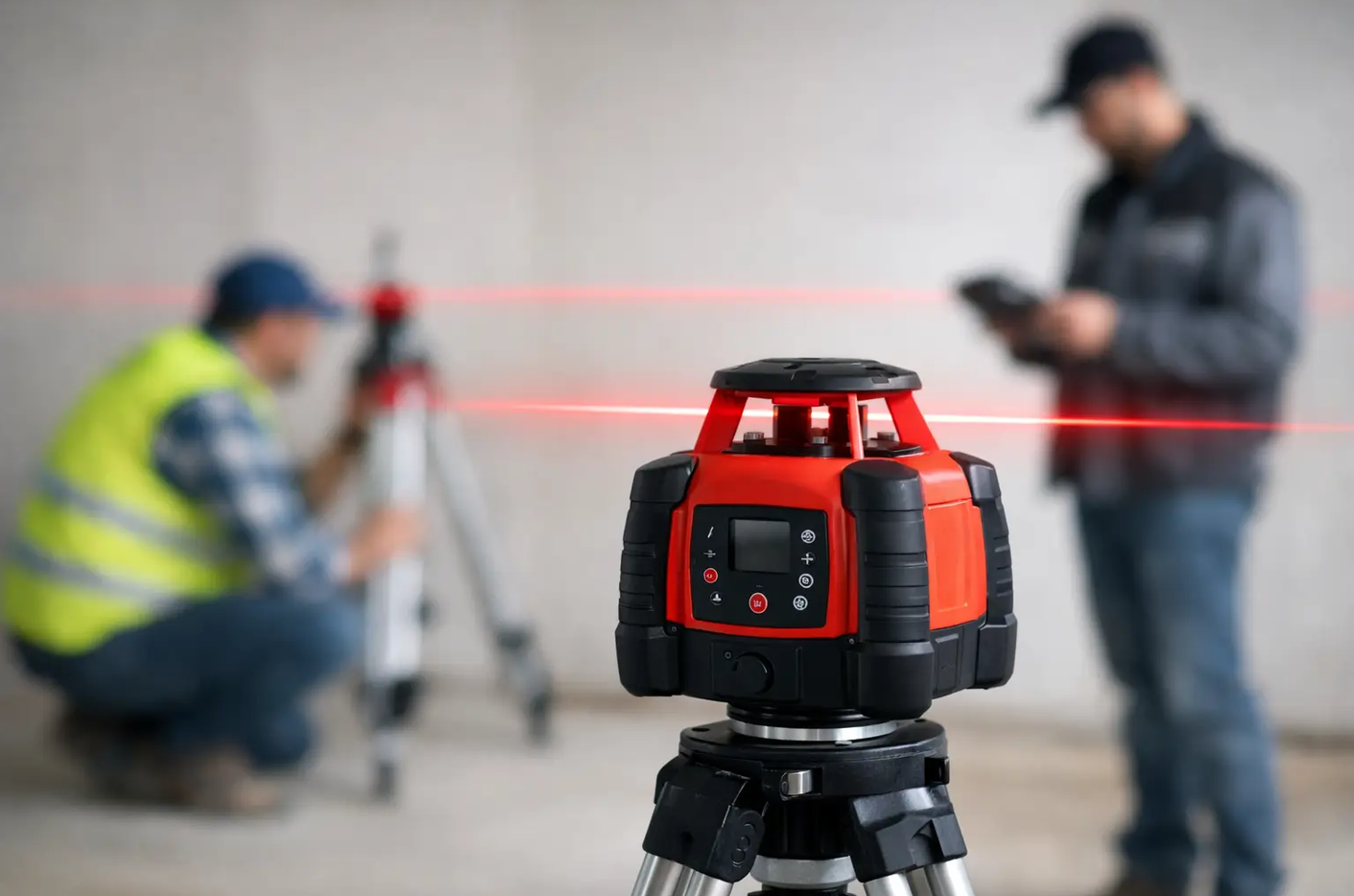
After self-leveling, the rotating laser creates a horizontal plane. Its accuracy is mainly determined by the compensator, electronics, optics and the correct adjustment of the individual axes of the device. Calibration is a professional adjustment in which the actual plane is compared with the value created by the laser, and any deviation is adjusted according to the manufacturer's tolerance.
Two things need to be distinguished. You can check the accuracy on site and it should be done regularly. The calibration itself or intervention in the adjustment elements belongs to the service. In some models, you can find a screw or a service menu after opening the cover, but unprofessional intervention can break the second axis, damage the seal or worsen the accuracy more than the original error.
Accuracy is usually stated as ±1 mm per 10 m or ±1.5 mm per 10 m, for example. This does not mean that the laser will be off by exactly this amount at every point. It determines the permissible deviation of the measured plane at a given distance and measurement method. The longer the working section, the more noticeable even a small tilt will be.
When to check the accuracy of the laser
It makes sense to check before any more demanding work, where a mistake is expensive to fix. This is especially true before concreting, setting out foundation heights, laying sewers or when working with a slope. Normal indoor installation can withstand a less strict regime, but even there it is worth checking the device after transport.
Always have the laser checked after a fall, a strong impact, after getting wet outside the declared protection or if it has been stored in a humid and dusty environment for a long time. Also be careful of the situation when the device turns on and self-leveling takes place without an error message, but the measurements between days are not correct. A functional compensator does not automatically mean that the plane is set correctly.
In professional use, it is wise to perform a self-check at least once every few months and a service calibration depending on the intensity of use, usually once a year. A company that has a laser in its van and on excavations every day needs a stricter regime than a craftsman who uses it a few times a month.
Simple two-point control
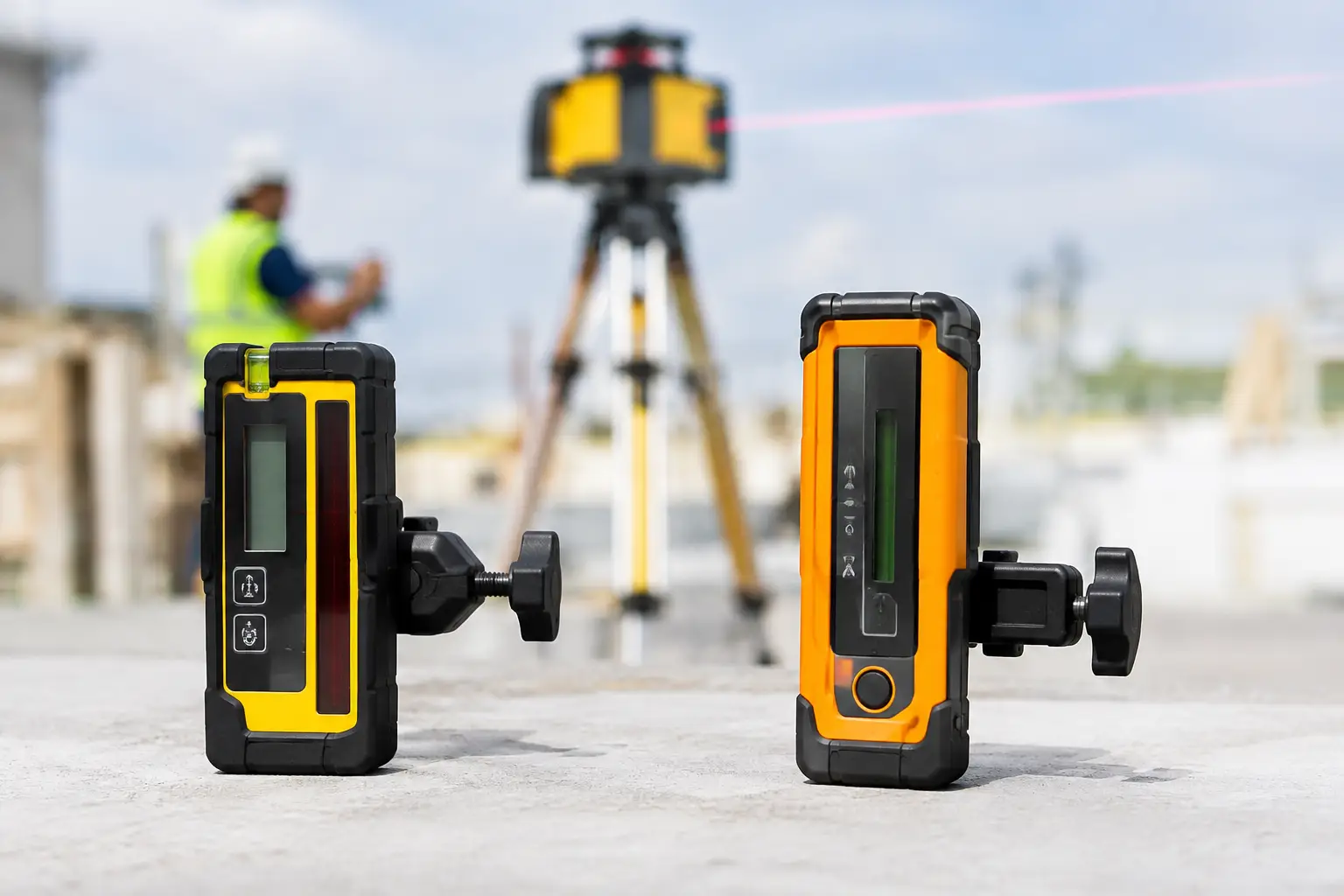
For an approximate check of horizontal accuracy, you need a stable tripod, a level or laser staff with a receiver, and two points approximately 20 to 30 meters apart. Use the receiver outdoors - even the green beam is not reliable for accurate readings in direct sunlight.
First, position the laser approximately midway between points A and B. After self-leveling, read the height with the receiver on the staff at point A and then at point B. When the laser is in the middle, any tilt of the plane will be reflected similarly on both sides, so this measurement will provide you with a basis for comparison.
Then move the device as close to point A as possible, ideally about 1 meter from the staff, while point B remains in its original location. Read the height again at point A and then at point B. Compare the difference in heights between the points from the first and second measurement. If the difference has changed significantly, the laser is probably not within tolerance.
Example: at a distance of 30 meters, the difference will be 6 mm. If the manufacturer states an accuracy of ±1 mm at 10 m, the permissible deviation must be assessed according to the specific methodology and model parameters. However, such a result is a clear reason to repeat the measurement, exclude a tripod error, and, if the deviation is confirmed, send the device for service.
Repeat the check after rotating the laser 90 degrees. Rotary lasers have two measuring axes, X and Y. It is possible that one is correct and the other is off. This is especially important for digital grade models, as an incorrectly set axis can ruin the accurately entered longitudinal or transverse grade.
Conditions that distort the result
Before you declare a laser as faulty, eliminate common sources of error. The tripod must be on solid ground, the staff must be vertical, and the receiver must be tightened firmly. On soft ground, one leg of the tripod may sink during the reading. In strong winds, the movement of the staff or the vibration of the tripod may create a difference that is not related to the calibration.
Do not work close to hot asphalt, over fresh concrete or near a source of strong heat. Air waves over a longer distance can impair the stability of the reading. When checking, it is worth taking several measurements and writing them down. One random reading is not proof, but a repeatable difference is.
Why does the laser become out of calibration?
The most common cause is impact. All it takes is a fall off the hood of a car, an overturned tripod, or a long ride with a loose suitcase in a van. The device may look undamaged on the outside, but the sensitive internal mountings will take a beating.
Improper storage is also a problem. The laser should be in a case, dry, with a clean beam window and no loose accessories around the body of the device. If you work in dust, clean it with a soft dry cloth after work. Do not blow it aggressively with compressed air from a short distance so that dirt does not push against the seals and optics.
A separate chapter is about discharged or unsuitable batteries. Weak power supply usually does not cause calibration, but it can cause unstable operation, rotation interruptions or error messages. Therefore, when diagnosing, first use a fully charged correct battery or prescribed batteries.
When inspection is not enough and service is needed
If you have repeated the measurement in stable conditions and the deviation remains, do not use the device for precise work at height. Mark it so that it does not accidentally return to the construction site, and have it checked. The service does not only deal with the axis adjustment itself. It also checks the self-leveling, rotary head, beam receiver, power supply, control and the condition of the cover.
When buying a new laser, it makes sense to request a pre-calibrated unit. Rotary Lasers - Levels deliver new devices calibrated before sale and handle warranty and post-warranty service, including available parts. This is especially practical when the laser is not an accessory in the suitcase, but a working tool on which the entire lot depends.
When servicing, ask whether the horizontal accuracy in both axes has been checked, whether a functional test of the compensator has been performed, and whether you will receive information about the measured deviation. For a device used for slopes, it makes sense to also check the manual slope mode and communication with the digital receiver.
Calibration is not an extra expense if it means you won't have to fix a bad slope, level the concrete, or explain to the customer why the set heights don't fit. A few minutes of checking is enough before the next precise job. If the result doesn't fit, troubleshoot the laser before you start troubleshooting the finished job.