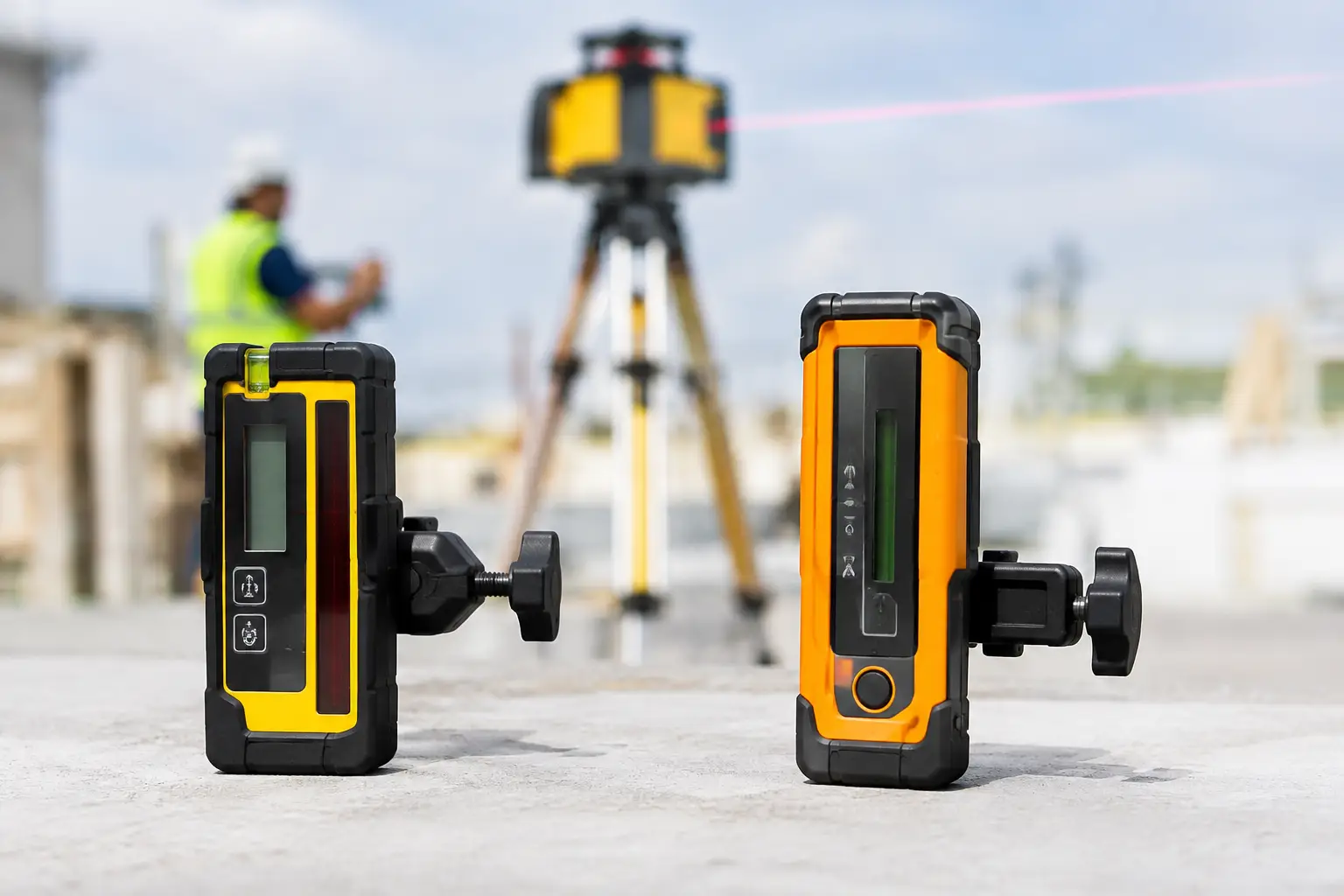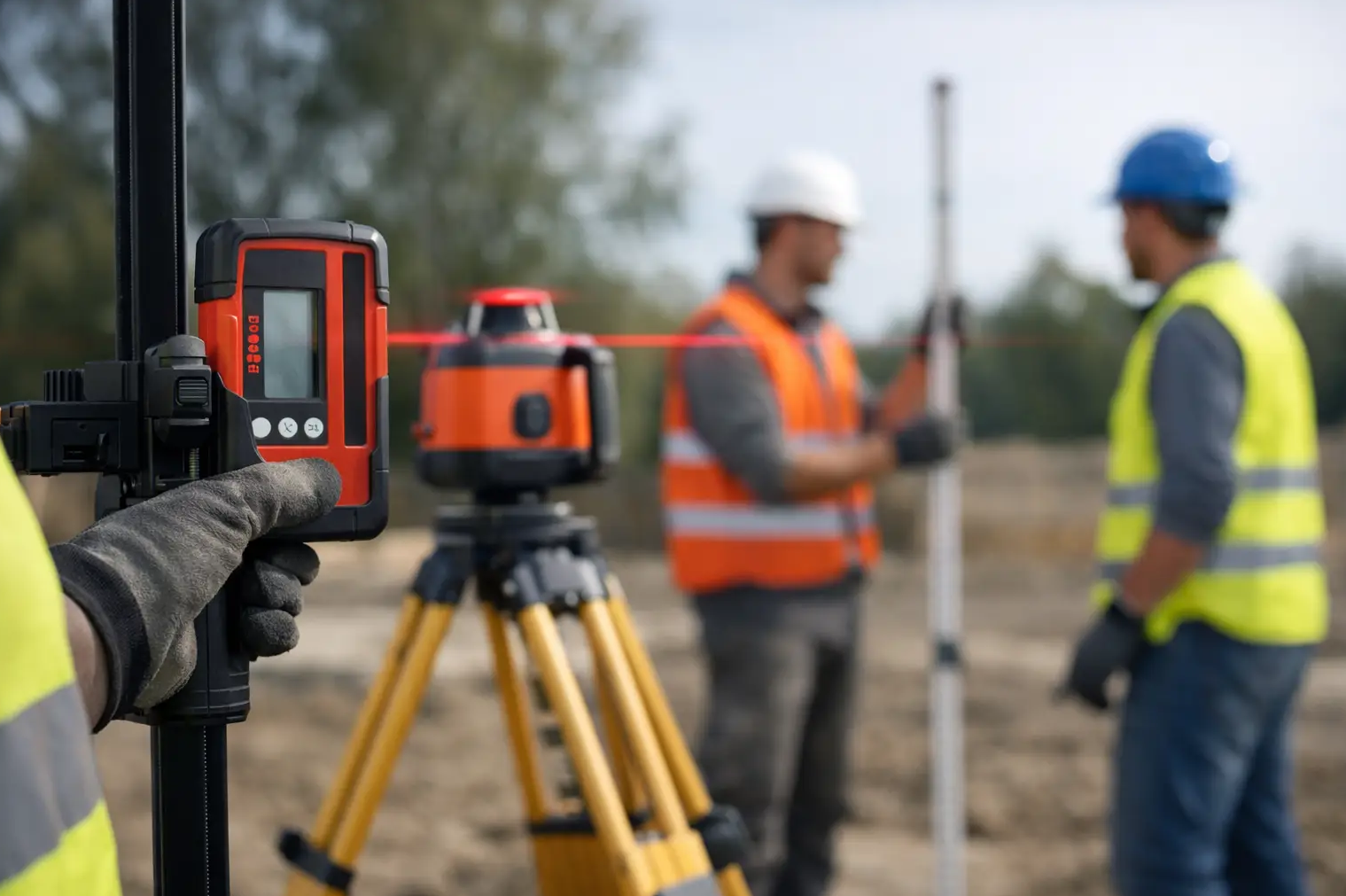
When digging, pouring concrete or laying curbs, the rotating beam alone in the sun is often of no help. The beam may be precise, but it is simply not visible to the naked eye. It is the external receiver for the rotating laser that turns the rotating laser into a full-fledged work tool for the outdoors. It captures the laser plane, signals the position and allows you to quickly determine whether the batten needs to be raised or lowered.
For the craftsman, this means less guesswork. For the contractor, it means less downtime checking heights. The receiver is often more important than the color of the beam itself when leveling outdoors. Both red and green lasers can work accurately if the right sensor is selected and the entire system is set up for the job.
What is the purpose of an external receiver for a rotating laser?
The rotating laser creates a horizontal, vertical or inclined plane when rotating. The receiver has a sensitive window with sensors on the front. When the laser beam passes through this window, the device evaluates its position relative to the center of the receiver.
The result is shown by a display, LEDs or an audible signal. If the receiver is too low, it signals the direction upwards. If it is high, it guides the operator downwards. The central position means the height reached - the laser plane. In normal work, it is sufficient to attach the receiver to the leveling staff, place the staff on the measured point and adjust its position according to the signaling.
This procedure is used in excavations, subgrades, foundation slabs, concreting, sewer installation and terrain modification. At a shorter distance indoors, the beam can be clearly visible. However, outdoors, intense daylight significantly reduces its visibility. The receiver is therefore not a useless accessory, but a working tool for precise leveling over a larger area.
Conventional and digital receiver: the difference in operation
A standard receiver will show you whether you are above level, below level or exactly in the middle. It is a practical solution for most work at height. Operation is guided by arrows, sound and a centre mark. When setting out foundations or checking the height of formwork, you work quickly and without complicated adjustments.
The digital receiver supplements this information with a specific deviation from the center, usually in millimeters. Instead of moving the receiver along the staff only according to the arrows, you can see, for example, that you are 12 mm above the plane. This is a noticeable advantage when placing elements precisely, checking finished heights or working according to project dimensions.
However, digital reading does not mean that every worker needs one. For rough earthworks, a classic receiver can be faster, cheaper and completely sufficient. If you regularly measure height differences, check slopes or hand over precision work to another profession, the digital version saves time and repeated measurements.
Receiver accuracy and laser accuracy are not the same
The selection also considers the accuracy of detection, sometimes referred to as fine, medium and coarse tolerance. The fine setting responds to small deviations from the center and is suitable for more precise assembly or concreting. The coarse setting captures the plane faster in field work and at a greater distance.
The overall accuracy is also determined by the rotating laser itself, its calibration, the correct position of the tripod and the distance from the workplace. The receiver cannot correct a miscalibrated laser. Therefore, it is important to buy the device pre-calibrated and have it checked if you suspect a fall or inaccurate measurement.
Compatibility matters more than a universal name
Not every external receiver works with every rotary laser. The color and wavelength of the beam, the laser's operating mode, the rotation speed, and the electronic compatibility of the specific model are decisive. A receiver designed only for the red beam may not reliably capture the green laser. Similarly, a receiver from another brand may respond, but may not achieve the declared range or work correctly in all modes.
It is safest to choose a receiver designed specifically for the laser model or a proven compatible type. Before ordering, you need to know the designation of the rotary laser, the color of the beam and the purpose of the work. If you are using a digital laser to set slopes in the X and Y axes, also check its modes when working with slope. With some devices, after activating the slope, the signaling method changes or it is necessary to adjust the receiver settings.
Also, be careful with the label “universal.” It does not automatically mean flawless cooperation with all devices on the market. It may be a usable solution, but for professional work it is better to have compatibility confirmed in advance than to test the equipment directly on the site.
Reach, mount and durability in real-world use
The declared average working range applies to the laser and receiver set, not to the receiver separately. The range is affected by weather, sun intensity, optic cleanliness, battery condition, correctly set rotation and laser position. In open areas, it is therefore wise to leave a margin. If you are working on a larger foundation slab or a long excavation, do not select the set just at the limit of the required distance.
The holder on the staff is as important as the sensor. It must hold the receiver firmly so that its position does not change when the staff is moved. Play in the holder can create unnecessary errors in precision work. Use a solid leveling staff with a readable scale and always place the receiver perpendicular to the direction of the beam.
Outdoors, you'll appreciate a more durable design, well-protected buttons, and protection against dust and splash water, such as IP54. This doesn't mean the device should be left in the rain or washed with pressure water. It means it can handle common construction dust, humidity, and more demanding work environments better than sensitive office electronics.
Correct procedure for measuring on a staff
First, place the laser on a stable tripod or solid surface away from the area where the machinery will be moving. After self-leveling, turn on the rotary mode and set the receiver to the desired sensitivity. Mount the receiver on the staff with its sensing window facing the laser.
Hold the staff vertically. For uneven or soft ground, check that the heel of the staff has not sunk in. Move the receiver along the staff until it shows the center. Then read the height on the staff or mark the position as needed. When transferring the height to multiple points, do not change the position of the laser. If you move it, you must re-verify the reference point.
The measurement is fastest when working in pairs: one worker stands at the staff, the other monitors the excavation, formwork or machine. When working alone, the loud sound signal of the receiver is useful. You do not have to constantly look at the display and at the same time you can hold the staff in the correct position.
When is the problem in the receiver and when in the settings?
If the receiver does not respond, do not immediately start complaining. First, check the batteries in the receiver and the laser, the cleanliness of the sensing window and whether the laser is actually rotating. For a green laser, make sure that you are using a receiver designed for the green beam. Distance is also important - outside the working range, the signal may be weak or non-existent.
Irregular signaling can be caused by a slanted staff, a beam reflected from a shiny surface, or the movement of the laser on an unstable tripod. If the heights between the points repeatedly do not match, verify the laser at a known reference point. In the event of a fall, transportation without a case, or prolonged intensive use, the correct course of action is to check the calibration, not to make further adjustments by guesswork.
At Rotary Lasers - Levels we can advise you on choosing a compatible receiver, holder and suitable staff. Before selling the device, it makes sense to check and adjust it so that you do not go to the construction site with equipment that needs to be tested first.
So, when choosing, don't just base your decision on the price of the receiver. Consider the type of laser, the required accuracy, the real distance, and whether you will be working at height, in terrain, or on a slope. A well-chosen receiver won't show up in a catalog, but when you find the exact height for the first time in bright sunlight.