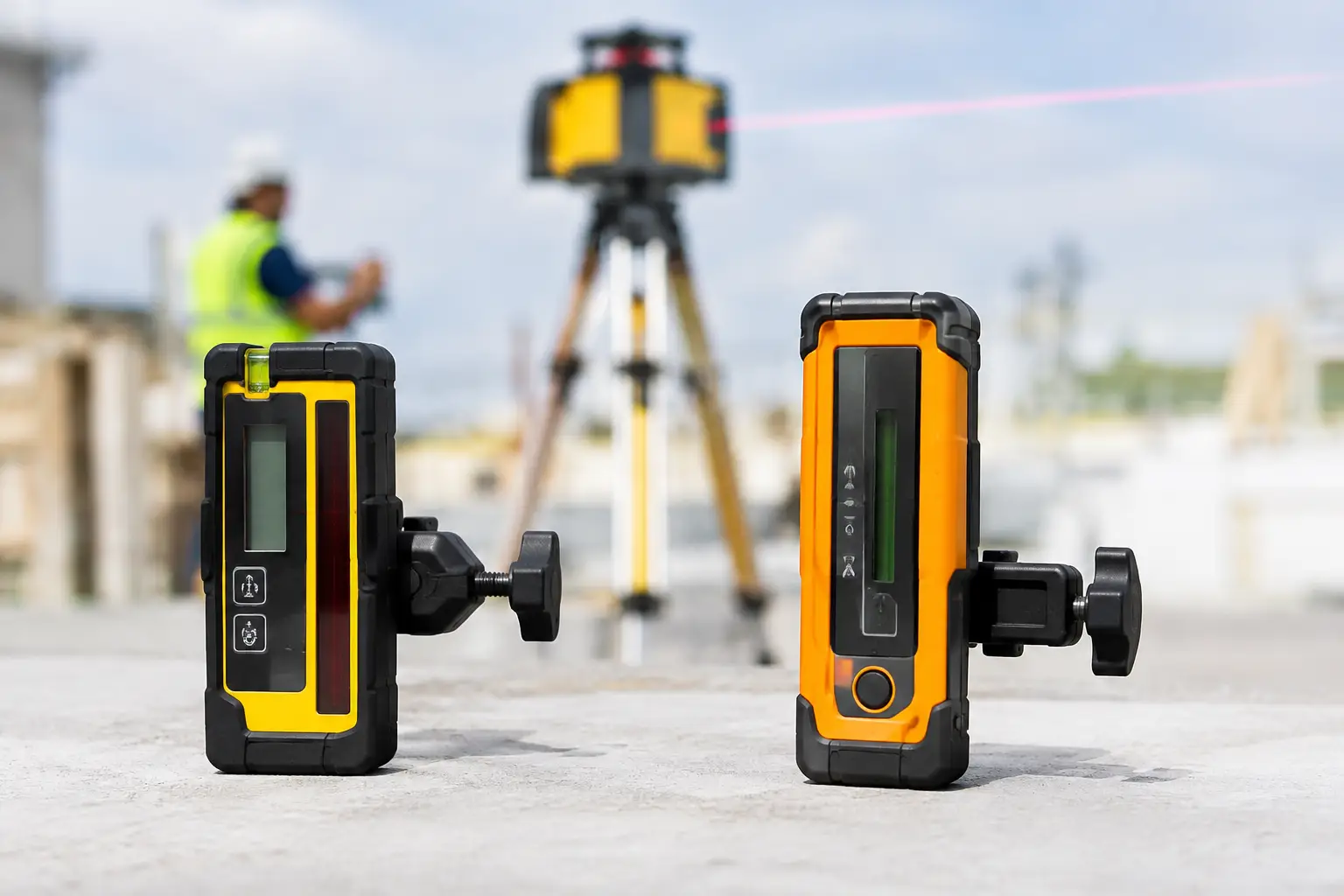
When working with a rotating laser, a small amount of play in the mounting is enough and the measured height can fluctuate by millimeters. The receiver holder for the leveling staff is therefore not an insignificant accessory. It holds the receiver exactly in the axis of the staff, allows you to quickly capture the laser beam and ensures that the reading is repeatable with every measurement.
When digging, pouring concrete or laying curbs, the pace of work is often decisive. When the receiver on the batten slips, twists or cannot be tightened tightly, the worker wastes time repeatedly checking the height. A good holder should be simple to use: attach, adjust the height of the receiver, tighten tightly and measure.
Why is the receiver mount on the leveling staff important?
The external receiver captures the rotating laser beam where it is not visible to the naked eye - especially in the sun, at a greater distance or when working with a red laser. The leveling staff transmits the measured height directly to the terrain. The holder is the connecting element between them and its accuracy affects the entire working set.
If the receiver is not mounted parallel to the batten, its reference line may be shifted. For rough earthworks, a small deviation may not be decisive. However, when laying sewer pipes, installing footings, implementing a floor or checking the height of the formwork, a few millimeters can mean the difference between good and repaired work.
Repeatability is also important. When a worker moves the receiver throughout the day, they must be able to place it on the batten without searching for the right position and without improvising with tape or zip ties. These do not belong in construction. They cannot withstand precise adjustment due to shocks, dust, and normal transportation.
Proper compatibility is more than just the width of the batten
First, you need to find out what profile your batten has. Aluminum leveling battens with a rectangular or oval profile are commonly used, or special battens supplied in a laser kit. The holder must fit the entire surface of the given profile and the clamping mechanism must have sufficient range.
A universal mount is useful if you use multiple battens or work with different receivers. However, versatility has its limits. Too much play on a narrow batten can cause the receiver to move sideways. For professional everyday use, it is better to have a mount that fits a specific type of batten tightly, not just loosely.
Also check the mounting of the receiver itself. Some receivers use a guide groove, others a screw, a spring clamp or a combination of these solutions. If the mount only holds the receiver loosely, it may fall out when the batten is turned or hit. A replacement receiver costs significantly more than a properly selected mount.
When purchasing a separate accessory, it makes sense to tell the seller the exact model of the laser and receiver, or send a photo of the back of the receiver. This will avoid a situation where the new mount looks mechanically correct but does not fit into the mounting rail.
Conventional and digital receivers need a stable foundation
With a classic receiver, you are guided by an audible signal, arrows or a center indication. You move the staff up or down until the receiver announces the level. The fixed holder helps to keep the receiver in the set position and speeds up repeated measurements.
With a digital receiver, stability is even more important. A digital sensor can display the deviation from the plane in millimeters. If the holder is tilted or the receiver moves on the staff, the exact reading on the display is of no practical value. Digital measurement is suitable where you need a specific deviation value, not just information about whether you are above or below the plane.
What determines the quality of the holder?
In the photo, the mounts look similar, but the difference will become apparent after a few days in the field. A solid body made of high-quality plastic or metal is better able to withstand drops and normal stress. A metal mount may not automatically be better - it depends on the design, precision of the guide, and the quality of the screw. A cheap metal mechanism with a weak thread may be worse than well-processed engineering plastic.
The size and shape of the tightening screw is important. A small, smooth knob is difficult to use when wearing gloves, in mud, or in winter. A larger, knurled screw can be tightened more securely, but it should not protrude so much that it gets caught in the excavation or formwork.
Also pay attention to the receiver guide. The right holder holds it in one axis, without the possibility of spontaneous rotation. A quick-release lever is practical when the receiver is often moved between heights. A screw mount is suitable where maximum strength is a priority and the receiver remains in one position for a longer period of time.
When working outdoors, dust, sand and dried mud get into the mechanism. The holder with a simple design is easier to clean and has fewer places that can get stuck. After work, it is enough to clean the mechanism with a brush or a cloth. There is no need to pour oil on it, because this will unnecessarily attract dust.
Setting up the receiver on the batten in practice
Before taking the first measurement, lay the staff completely flat and check that the scale is clean and legible. Place the holder on the profile so that its contact surface is flush with the staff across its entire width. Then insert the receiver according to its mounting system and tighten both elements separately - first the receiver in the holder, then the holder on the staff.
When checking the height, hold the staff vertically. Even the best holder is no substitute for proper operation. If the staff is tilted, the receiver may detect the correct plane, but the reading on the scale will not correspond to the actual vertical height. For precise work, a circular spirit level on the staff or regular visual inspection from several sides helps.
When the receiver indicates level, read the value on the receiver reference line, not the random edge of the holder. Each model may have a line at a different height. If you change receivers while working, compare their reference positions and take into account any difference.
When transporting the assembly, it is safer to remove the receiver from the batten. Battens are often leaned against a car, loaded into a van, or carried over a ditch. This causes the receiver and bracket to receive a side impact that they are not designed to withstand. A short unhooking takes less time than replacing a damaged clamp or receiver cover.
When to replace the old bracket
Do not delay replacement if the holder on the staff moves on its own, cracks when tightened, or has a damaged thread. It is also a problem if the receiver is not held in the axis and can be deflected by hand. Such a part can create an error that the worker attributes to the laser or an uncalibrated staff.
After dropping the receiver, always check the mount before taking another measurement. A crack in the clamp may not be visible at first glance, but will be evident by movement when tightened. Check the tightness of the hold by hand and take a check reading at a known point. If in doubt, it is cheaper to replace the mount than to deal with an incorrect height on the finished structure.
In Rotary Lasers - Levels, when choosing accessories, you can address the specific combination of receiver, staff and rotary laser, not just order from a photo. This is especially useful for older kits, spare parts and digital receivers, where the mechanical attachment must fit precisely.
A good receiver holder for a leveling staff will not attract attention while it is working. That is its job: to hold the receiver firmly, allow for a clean reading, and not slow down the person who needs to have the height ready before the next truck with the material arrives.