When it comes to sewer connections, drainage or landscaping, it's not just about whether the excavation is level. It's about the exact slope. This is where the digital rotating laser has a big advantage over a conventional leveling laser: you can set the slope in the X and Y axes directly in the device, without the time-consuming task of manually positioning the tripod and repeatedly checking the heights.
For the craftsman or construction team, this means less measuring with a tape measure, fewer repairs, and faster delivery of work. However, a digital model is not automatically the best choice for every job. It pays off when you work with slopes regularly and need to set them repeatably, accurately, and without improvisation.
What does a digital rotary laser do differently?
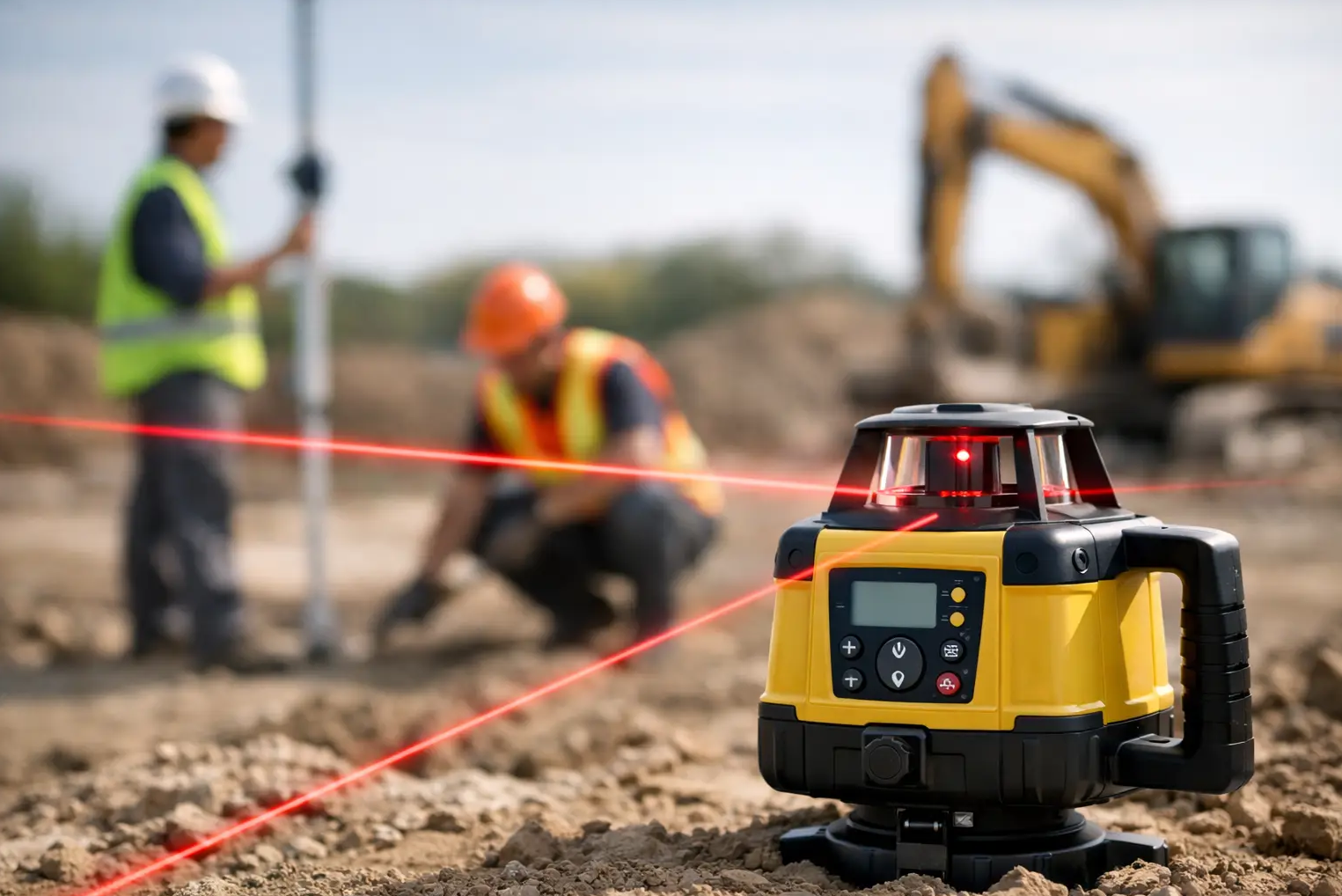
The classic self-leveling rotating laser creates a horizontal plane. When placed on a stable tripod, it levels itself within its working range and the receiver shows you whether the measuring staff is above, below or directly at the desired level. It is the right solution for foundations, formwork, concreting, installing suspended ceilings or checking terrain heights.
The digital rotating laser can also create a controlled inclined plane. You enter the slope in percentages or, depending on the capabilities of the specific model, in the X axis, the Y axis, or in both axes simultaneously. The laser then holds the set plane while working. With a pipe with a slope of 1%, a paved surface that drains water, or when preparing a bed for a gutter, you don't have to constantly calculate the height from the reference point.
It is important to distinguish between the manual tilt function and truly digital tilt adjustment. In simpler lasers, self-leveling can be turned off and the device tilted manually. This solution is sufficient, for example, for guiding a line, but you cannot make an exact slope from it without further measurement. A digital model allows you to enter a value directly and work according to it.
When is a digital rotary laser worth it?
It will be used most by companies and tradespeople who build sewers, drainage, water connections, interlocking paving, roads, parking lots, landscaping or preparing base layers. It also makes sense when assembling structures where the height and defined slope need to be transferred over a greater distance.
For one-off curb placement or regular concreting, a standard self-leveling rotating laser with a quality receiver may be more economical. However, if you are setting slopes every week, the digital version pays for itself in the time saved. Accuracy is not just a data sheet. It is less digging of the trench, less leveling of the base and less risk of water flowing in the opposite direction than it should.
When choosing, also consider the range of slopes required. For sewer and drainage work, smaller percentages are often sufficient, but for landscaping or specific installations, a larger range may be required. Don’t just choose based on the lowest price. Check whether the device allows adjustment in both axes, how the values are entered, and whether the operator can easily check them on the display or control panel.
Laser accuracy and result accuracy are not the same thing
Even a quality device needs proper positioning. The rotating laser must be on a solid tripod, away from vibrations from compaction equipment, excavators, or passing vehicles. If the tripod sinks into soft soil by a few millimeters during operation, this will be transmitted to the entire measured plane.
Manufacturers often state the accuracy in millimeters over a certain distance. This information should be read practically. With a short pipe in the yard, the difference may be negligible, but with a long excavation, every millimeter and every incorrect height transfer increases. Therefore, it is worth checking the reference point continuously, especially after moving the equipment, strong winds or after a longer break.
Before you start work, zero the laser. Choose a fixed point from which to base the depth or height and record the reading on the staff. If you are moving the laser to another location, do not try to base it on a guess. Return to the known point and verify that the system shows the same value. This will avoid an error that you would otherwise find when installing the pipe or during a final check of the grade.
An external receiver is essential when working outdoors
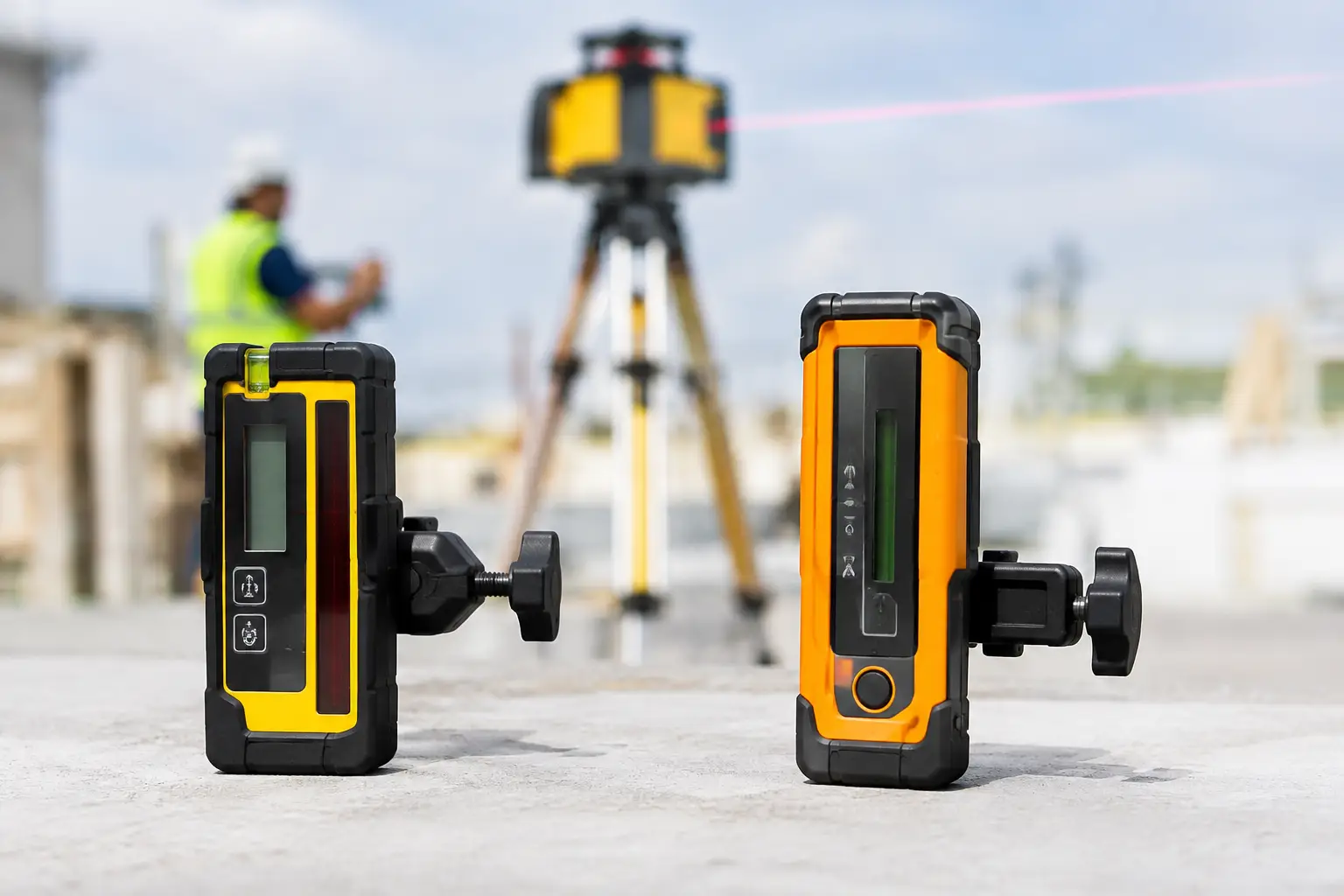
The rotating beam is not intended to be seen with the naked eye for tens or hundreds of meters. In the sun, visibility is often limited even with the green beam. An external receiver will pick up the rotating beam and use sound, arrows or a display to show where the baton needs to be moved.
For regular leveling, a standard receiver with above, below and on-level indication is suitable. For excavations, sewers and precise height adjustment, a digital sensor with millimeter reading is more practical. Instead of vague beeping, you can see exactly how many millimeters you are off the set level. It is noticeably faster when leveling a bed, gravel or concrete.
Use the receiver on a fixed staff holder. Holding it in your hand can introduce unnecessary deviations when taking repeated measurements. A five-meter staff is a common choice for earthworks, but for deep excavations or when transferring heights across terrain, check in advance whether its range is sufficient.
Red or green beam
With rotary lasers, the color of the beam is often considered the main parameter, but when working with a receiver, it is not the only decisive factor. The green beam is more noticeable to the naked eye, which helps indoors, during assembly and at shorter distances. The red beam is still fully usable and can be more cost-effective.
In the open outdoors, a high-quality external receiver, sufficient working range and device stability are the main factors. If you use the laser mainly for excavations and terrain, don't pay extra just for the color of the beam. If you often do interior installations where you need to see the line directly on the wall or structure, the green version can make your work more enjoyable.
Parameters to compare before buying
For a digital model, look at the leveling accuracy, self-leveling range, electronic slope adjustment range, and working range with the receiver. The rotation speed is also important. A higher speed improves cooperation with the receiver and, for some jobs, line visibility, while a lower speed can help when working indoors.
For construction, protection against dust and splashing water, such as IP54, is essential. This does not mean that you can leave the laser in the rain or immerse it in water, but the device will better withstand normal working conditions. Also look at the power supply. A rechargeable battery saves on operating costs, but when working all day, it is wise to have a charger or a second power source ready.
The kit is often worth more than the laser itself. The tripod, staff, receiver, receiver mount, case, and charger all have to work together. A cheap laser without a proper staff and receiver can slow you down more in practice than a complete work kit ready out of the box.
Calibration and service are crucial after purchase
A rotating laser is a measuring device, not an ordinary tool. A fall from a car, a bump into a tripod, or prolonged use in a harsh environment can affect its accuracy. Even if the self-leveling function works, the device may not measure correctly. That's why it makes sense to buy a device pre-calibrated and know where to have it checked or repaired.
At Rotary Lasers - Levels, new devices are delivered calibrated and parts, accessories and service are also available. This is a practical advantage with a working laser. If you damage the mount, lose the charger or need to verify accuracy, you don't have to worry about the device being out of work for several weeks without the possibility of repair.
Before any major job, do a quick check at a known point. Set up the laser, measure from one position, then rotate or move it according to the check procedure. If the results don't match, don't force the device to work just because it turns on. Calibration costs less than fixing a poorly sloped drain.
A digital rotary laser is best thought of as a work tool for repeatable, precise alignment, not as an extra piece of electronics. When you have a stable tripod, the right staff, a digital receiver, and a device with verified calibration, you set the grade once and then just check that the job is going according to plan.