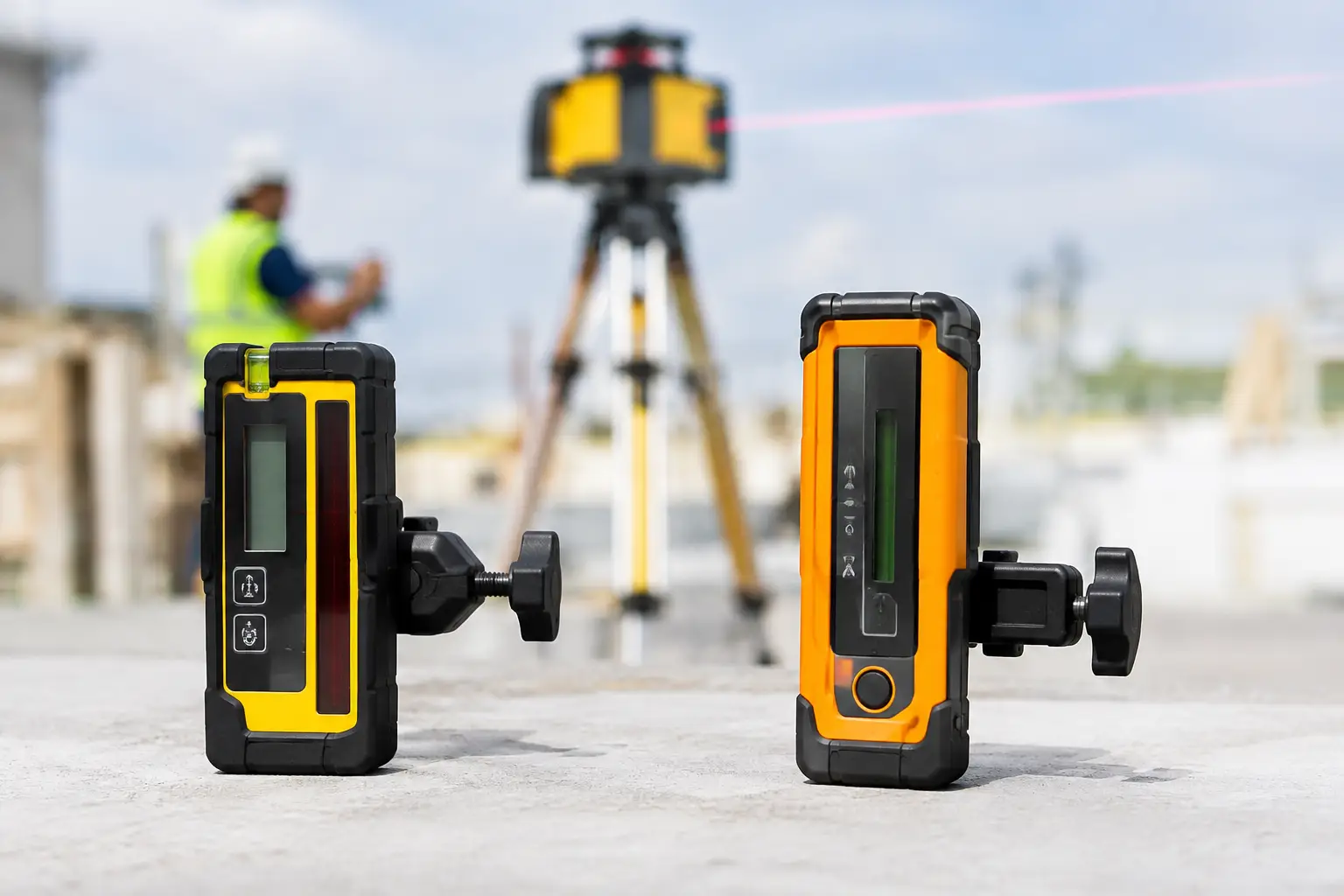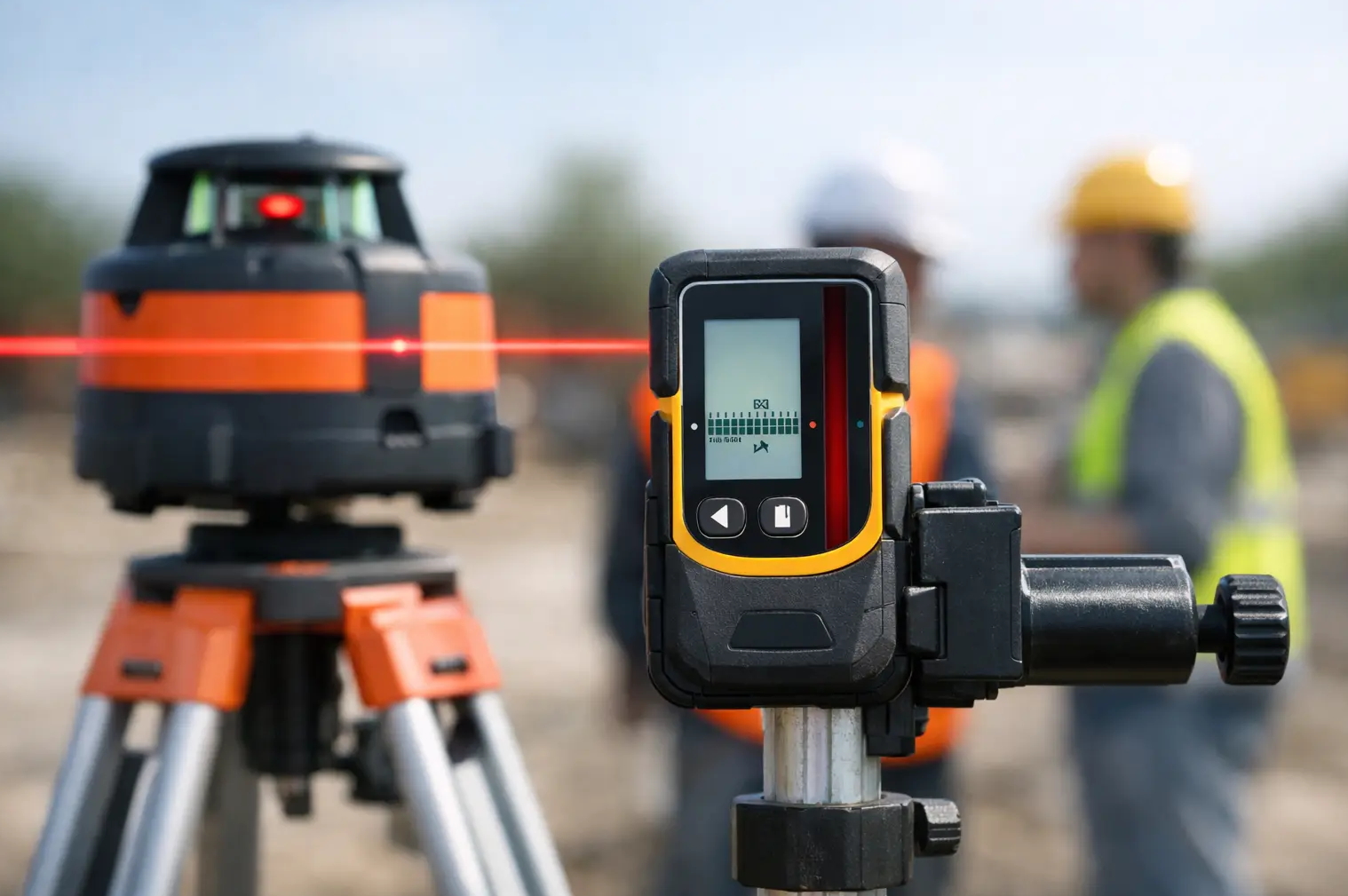
When concreting, millimeters are often decisive. If the worker at the staff only estimates the position of the laser plane based on the arrows or sound, each additional measurement takes time and the risk of error increases. The digital laser receiver with millimeter reading shows directly on the display how many millimeters it is above or below the reference plane. The work is faster, the control is clearer and the result can be better passed on to the next worker on the site.
A conventional receiver reliably tells you whether to go up or down with the batten. The digital model adds a specific number. When backfilling, placing curbs, checking formwork, excavating or adjusting the height of the concrete, it's a difference you'll see on your first day of work.
What exactly does a digital receiver show?
The rotating laser creates a horizontal, vertical or inclined reference plane. It is usually not visible to the naked eye outdoors in strong sunlight, so the receiver captures the rotating beam with its sensing window. After capturing the beam, it displays its position relative to the center mark of the receiver.
In the digital version, the display does not only show a direction arrow. It also shows the deviation, for example +12 mm or -8 mm. The sign and direction may be displayed differently depending on the model, so it is always worth checking the setting when taking the first measurement. However, the principle remains the same: the worker knows exactly whether to raise, lower the staff or adjust the working height by a specific value.
A millimeter reading does not mean that the entire system has an absolute accuracy of 1 mm at any distance under all circumstances. It is necessary to distinguish between the resolution of the display, the accuracy of the rotating laser itself, the distance from the device, the calibration status and the correct placement of the receiver. However, the number in millimeters is a very practical tool for accurate and repeatable control.
When is a digital laser receiver with millimeter reading worth it?
It has the greatest benefit in work where the height is checked not once, but dozens or hundreds of times. For a concrete slab, it is enough to set the zero point to the desired height and then continuously check the formwork, curry net, guide laths and fresh concrete. Instead of instructions a little up and down, the worker can directly see the value of the deviation.
It also works well in earthworks. When excavating foundations, preparing the subsoil, placing a gravel bed or modifying the terrain, you can easily compare the current state with the designed elevation. When working with an excavator, the receiver is an excellent tool for the worker who checks the depth or height of points. However, it does not replace a full-fledged machine control system or geodetic marking out for demanding construction sites.
In sewers, drainage and paved areas, slope is often also addressed. Here, it is important to be clear about the setup. The digital receiver will show the deviation from the laser plane, but the slope itself must be created by a rotating laser that can adjust the slope in the X and possibly Y axes. If the laser only works in the normal horizontal mode, the receiver will accurately measure the height, but will not create the desired slope of the pipe.
In assembly, repeatability is particularly beneficial. Are you installing anchors, steel structures, suspended ceilings, facade elements or technological distributions? You set the zero point to the reference height and check each subsequent point without lengthy recalculations. This will be especially appreciated by teams where several people take turns measuring.
How to work to make the data fit
Accurate readings begin before the receiver is turned on. Place the rotating laser on a sturdy tripod or stable surface, away from heavy machinery that is moving and transmitting vibrations. Allow it to complete self-leveling. For a digital grade model, first set the desired grade and make sure the device is not in a mode that only signals a change in position.
Mount the receiver on the staff with a suitable holder. The staff must be vertical, not tilted towards the worker. Even a small tilt at a higher point on the staff can create an error that unnecessarily spoils the accurate millimeter reading. For outdoor work, a classic leveling staff with a clearly legible scale will help, while for indoor installation, a solid holder on a profile or console is often sufficient.
Then determine the reference point. This can be the height of the finished concrete, the top of the curb, the projected excavation level, or a mark transferred from a drawing. Move the receiver along the staff until it catches the laser in the middle and record the value on the staff. This value is the zero working reference for the next points.
When taking the next measurement, do not rush to read. Hold or move the receiver slowly so that it has time to capture the entire rotating beam. If the reading on the display changes, first check the verticality of the staff, the mounting of the receiver and the stability of the tripod. Only then adjust the soil, formwork or assembled element.
What to look for when choosing
Not every digital receiver is automatically suitable for every rotating laser. Compatibility with the beam type and the specific device system is decisive. The receiver must reliably capture the red or green rotating beam within the working range of the laser. The green beam is often better visible when working indoors, but for longer outdoor distances an external receiver is required for both colors.
Note the size of the sensing window. A larger window will make it easier to initially capture the plane, especially when working at a greater distance or if the worker frequently changes the height of the batten. A smaller window may be more precise to control when making fine adjustments, but requires a steadier hand and more attention.
The accuracy setting is important. Some receivers offer coarse, medium, and fine tolerances. The coarse mode is fast for digging and rough landscaping. The fine mode is used for concreting, curbing, or assembly where you no longer want to work with centimeter deviations. The millimeter display is most important for fine adjustments.
On construction sites, the readability of the display from both sides, the backlight, the volume of the sound signal and the durability of the housing are also decisive. Dust, splashing water, mud and the occasional fall are part of normal work. A receiver with IP54 protection is a reasonable basis, but even a durable device should not be left in a puddle or thrown into the back of a car without protection.
Also check the power supply and the availability of the mount. A receiver without a fixed mount on the pole is in practice only half the solution. Always have batteries or a rechargeable battery ready, as low power can cause unstable capture and delays just when concrete is being poured or a technician is waiting.
Common mistakes that take away accuracy
The most common error is not a malfunction of the receiver, but an incorrectly positioned staff. If it is not vertical, the digital reading may look accurate, but it refers to the wrong position. When working on soft ground, use a solid pad under the staff and check that it does not sink during the measurement.
The second mistake is working with a laser whose calibration no longer meets the required accuracy. A rotating laser may need checking after a fall, rough transport or long-term use. If you are measuring important heights, verify the laser by taking a test measurement at two locations or have it checked by a service center. A pre-calibrated device is a good start, but regular checking is part of responsible work.
The third mistake is to confuse height measurement with slope control. A receiver with millimeter readings will accurately show the difference from the plane, but it will not replace a correctly adjusted slope laser or project dimensions. For sewers or terrain slope areas, first calculate and set the reference slope, and only then measure the deviations.
More precise work without unnecessary slowdowns
A digital receiver is an accessory that makes sense when you can use its readings to make immediate decisions. For rough excavations over a large area, a regular receiver with arrows may be sufficient. However, if you need to level the subgrade, the height of the formwork, or repeatedly maintain an exact height, millimeters on the display save time and material.
At Rotary Lasers - Levels, we solve similar setups practically: according to the type of work, the required range, the color of the beam and whether you will measure only the plane or also the slope. The correctly selected receiver, fixed staffs and calibrated rotary laser will make accurate measurement a routine task, not a delay before the next stage of work.