When a Bosch rotary laser stops holding its height, doesn't charge, or reports a receiver error, it doesn't necessarily mean you have to buy a new device. Bosch level parts can make repairs significantly cheaper, but only if they are selected based on the exact type of device, its version, and the actual cause of the malfunction. A similar-looking cover, battery, or holder may not have the same mount, connector, or electrical parameters.
Time is of the essence when working on a construction site. A malfunctioning laser can stop concreting, structure installation and excavation work with a slope. Therefore, it is worth knowing which parts are commonly replaced, when replacement makes economic sense and in which cases the device should always be checked and calibrated after repair.
Select Bosch level parts by model
The Bosch label alone is not enough. The manufacturer has several generations of cross, line and rotary lasers, and there can be differences even between devices with very similar names. Before ordering, read the exact model label, production or serial number and battery label if you are dealing with power supply.
It is also important to identify the specific part that is failing. A laser that flashes when turned on may appear to be a battery problem. However, the cause could be a damaged charging contact, a broken wire, a faulty charger, or a blocked self-leveling mechanism. If you buy a part based on a photo alone, the risk of error is unnecessarily high.
For a rotary laser, check the power supply voltage, connector type, mounting method, and compatibility with a specific generation of the device. For receivers, the range of detected rotations, beam type, and communication with the laser are also important. Versatility has its limits - especially with digital systems and tilt adjustment functions in the X and Y axes.
A photo will help, but it will not replace the information on the label
A photo of the damaged part is useful for consultation. It will show the shape of the cover, the connector, the condition of the contacts or a crack in the holder. However, to correctly identify the part, please also send a photo of the device label and briefly describe what the level does when turned on. Whether the indicator light is on, the head rotates, responds to the charger, or whether the receiver catches the beam.
This saves money and downtime. Sometimes it is enough to replace a damaged part, other times an incorrectly ordered part would just be an additional expense without any results.
Which spare parts are most often lost?
In normal use on construction sites, the parts that are handled every day are the most affected. These include batteries and battery boxes, chargers, power connectors, covers, rubber protection elements, swivel heads, tripod threads and receiver holders for the leveling staff. Dust, moisture, falls from a height and transport in a loose box will show themselves sooner than the wear and tear of the electronics themselves.
Power supply is one of the common causes of problems. After years, the battery may have a smaller capacity, but it may not automatically be defective. First, it makes sense to check whether the charger provides the correct voltage and whether the contacts are not oxidized or pressed in. A cheap replacement without proper protection risks overheating, short life or damage to the electronics. For a work device on which the whole team depends, it is safer to choose a compatible and proven part.
Mechanical damage often occurs after a fall. A cracked cover may look like a cosmetic issue, but a damaged seal allows dust and moisture to enter the device more easily. IP54 protection helps with normal operation, but it does not protect against driving in puddles, pressurized water, or an open damaged cover.
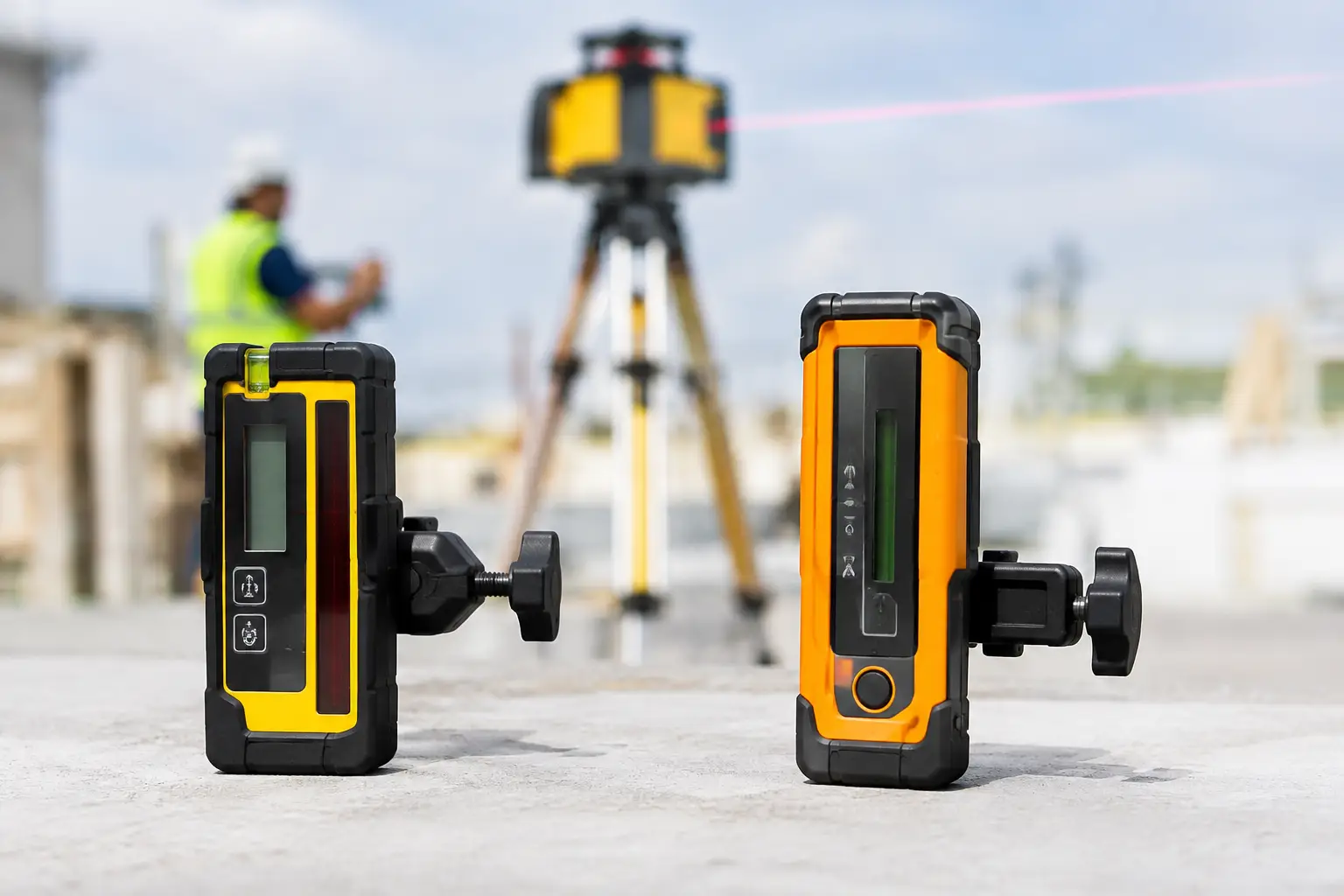
The receiver and its holder are other places where it is not worth improvising. The holder must hold the receiver firmly and perpendicular to the staff. If it shifts or is bent during the measurement, the height reading may not be correct. With a digital sensor with a millimeter reading, such inaccuracy is especially unnecessary.
When is a part enough and when is service needed?
Replacing a charger, battery box, cover, holder or damaged batten is usually straightforward. However, here too, the thread, size and voltage must match. For components that do not interfere with the measuring part, the calibration usually does not change after proper assembly.
A different situation occurs when the rotary head, self-leveling system, electronics or optics malfunction. The laser may shine and rotate normally on the outside, but the plane may not be accurate. In a small room, you may not see the difference. At 30 or 50 meters, the error may indicate poorly installed formwork, a concrete height outside the design, or a problem with laying pipes with a slope.
After a fall, mechanical intervention or repair related to the measuring unit, the device needs to be checked for accuracy. Calibration is not an additional service for perfectionists. It is a verification that the device really transfers the reference plane to where you need it on the construction site.
If you don't know whether the fault is in the part or in the laser module itself, it is not worth buying more parts blindly. Diagnostics and subsequent service are often cheaper than a series of unsuccessful replacements. Rotary Lasers - Levels handle spare parts, repairs and calibration, and during a personal visit in Švábovce near Poprad you can consult the condition of the device directly with a technician.
Easy check before ordering
Before you start looking for a part, do a basic test on a clean and stable place. Check the power supply, the condition of the contacts and the correct insertion of the battery. For a rotating laser, observe whether self-leveling is completed after switching on, whether rotation starts and whether the receiver responds at an appropriate distance.
If possible, compare the height of the laser plane on two opposite walls or points. Place the device between them, mark the values, then rotate or move it according to the usual checking procedure. A significant difference may indicate a miscalibration. However, such a test is not a substitute for professional calibration - it will mainly help to determine that the problem is not only in the battery or accessories.
At the receiver, first change the batteries, clean the sensing window and check the sensitivity mode. In direct sunlight, you will often not be able to see the beam with the naked eye, even with a fully functional laser. An external receiver is an essential work accessory when working outdoors, not a sign of a malfunction of the red or green beam.
Original part, compatible replacement or new device?
The decision depends on the cost of the repair, the age of the device, and what accuracy and functionality you need today. If the charging or accessory is damaged, a replacement part makes clear sense. If the old electronics are seriously damaged, the cost of the repair should be compared to a new, pre-calibrated device with a warranty.
If you often work outdoors over long distances, a rotary laser with a receiver may be a good choice. If you regularly do drainage, landscaping, or foundation work, a digital model with slope adjustment may be more useful than repeatedly reworking the functions on an old device. Conversely, for occasional indoor installations, replacing an expensive part may not make economic sense.
An available part is good news, but a correctly identified fault is even more important. Before purchasing, prepare the data from the label, a description of the fault and photos. You will get a part that has a chance of actually fixing the problem, and the leveler will return to the construction site without unnecessary waiting.