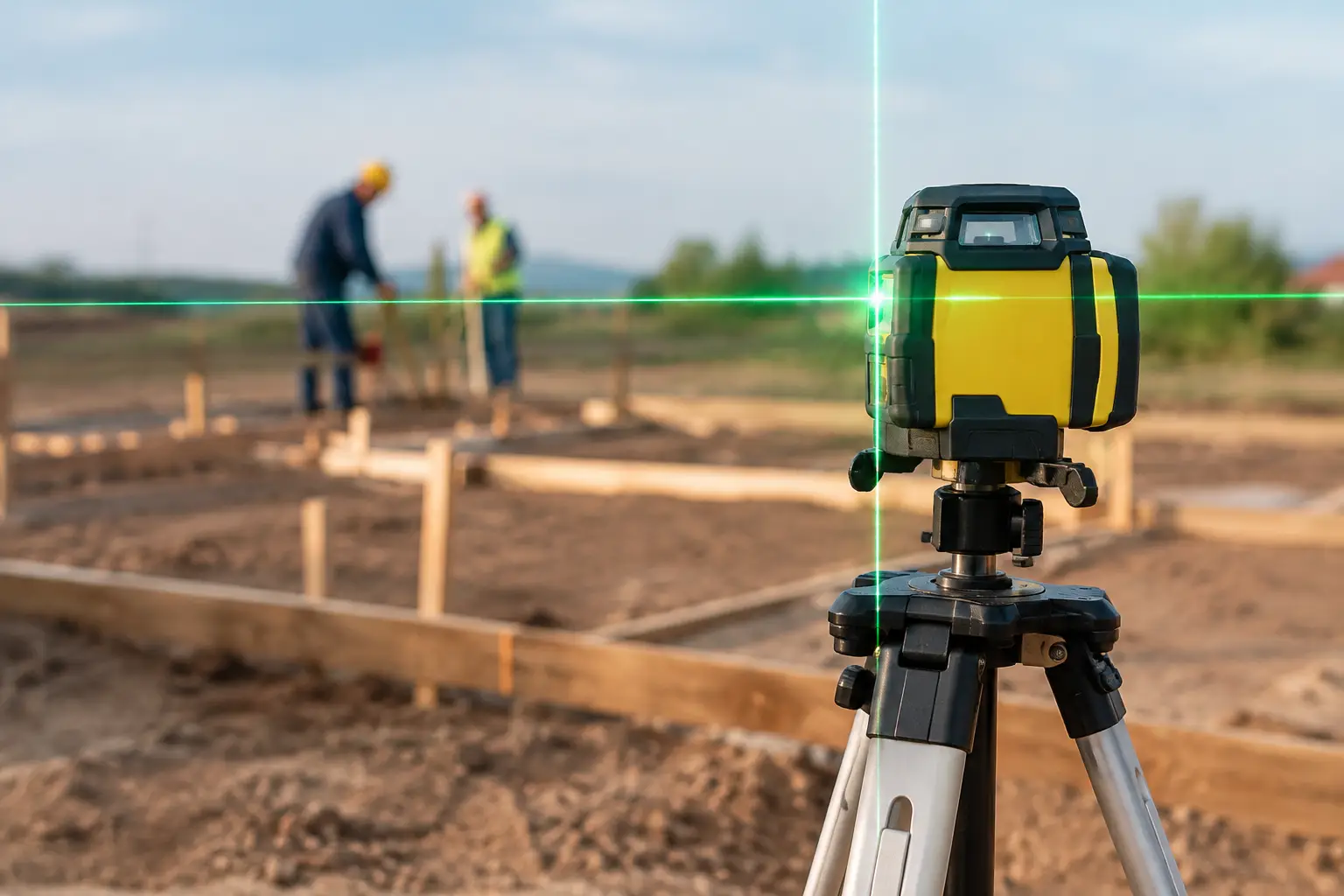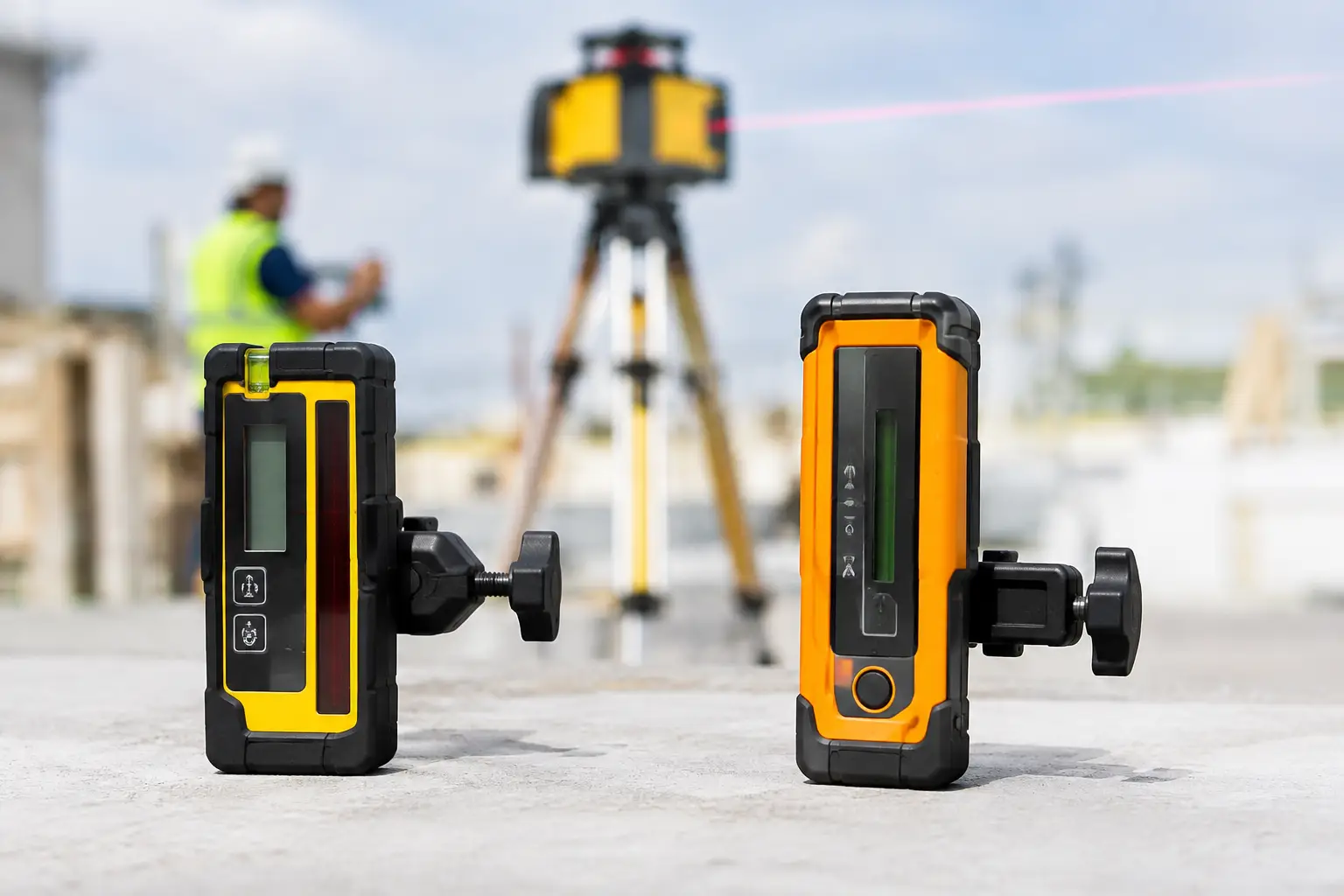
When concreting a foundation slab or laying a sewer pipe, millimeters are often the deciding factor. Analogue versus digital receiver is not just a question of the price of accessories for a rotating laser. It determines whether the worker on the pole quickly finds the correct height or whether he will have to repeatedly adjust the position according to flashing diodes and instructions from a colleague.
An external receiver, also called a sensor, captures the rotating laser beam where you can no longer see it with your eyes. It is practically always needed in the sun, and at greater distances as well. The red and green beams may be invisible to humans outdoors, but the receiver will reliably evaluate their position. The difference between an analog and digital model is mainly in how precise the information is given to you.
What does an analog receiver show?
The analog receiver works simply and reliably. With LED lights and an audible signal, it indicates whether the receiver is above, below, or exactly on the reference plane. If the staff is too high, the sensor will guide you in one direction, if too low, in the other. The center LED or a continuous tone indicates the correct height.
For many construction jobs, this is completely sufficient. When excavating, rough leveling the terrain, installing formwork, laying brickwork or checking the height of the excavation, you mainly need to know whether you are on the mark. An experienced worker can work quickly with a regular receiver and without unnecessary viewing of the display.
Its advantage is clarity. The diodes are clearly visible, you can hear the sound even while working, and a new worker can understand the controls in a few minutes. It is also usually a more affordable solution. If you mainly measure a plane and do not need to record height differences in millimeters, an analog receiver has a very good price-performance ratio.
However, you should take into account that you evaluate the result according to the width of the capture field and your own movement of the batten. The receiver will tell you where to move, but it will not tell you, for example, that you are exactly 18 mm above the reference height. This information is useful for fine-tuning or systematically adjusting the slope.
Analog versus digital receiver in practice
The digital receiver has the same basic task as the analog model: to find the plane created by the rotating laser. In addition, it displays the deviation from the center on the display, most often in millimeters. Instead of the instruction to move a little lower, the worker sees a specific figure, for example +12 mm or -7 mm.
This speeds up work where you need to specifically compensate for the difference. When installing steel footings, checking heights before concreting, assembling structures, laying paving or when installing drains, you don't have to guess how much to move the batten. You see the reading, make the correction and check the status again.
The digital display also reduces the risk of different interpretations between two workers. One does not have to shout to the other that they need to go just a little lower. It is enough to announce the specific value. On a larger construction site, where heights are transferred between multiple points, it is easier to maintain the same workflow.
However, a digital receiver alone will not increase the accuracy of a rotating laser. Accuracy is still determined by the laser, its calibration, working distance and correct positioning on the tripod. A digital sensor primarily makes the reading more precise and saves time when leveling. Even the best display will not help if the laser is out of calibration after a fall or is standing on a soft, moving surface.
Millimeter reading is not always necessary
When choosing, it is not worth automatically assuming that a digital model is right for everyone. If you use the laser once in a while for excavations, fence posts or rough terrain preparation, an analog receiver will do the job without limitations. In addition, it may be wiser to invest in a more solid batten, a quality mount or a tripod.
A digital receiver is especially worthwhile when you repeatedly deal with height differences and every extra centimeter means rework, material or delay. A typical example is the slope of a sewer . With pipes, it is not enough to know that you are approximately level. You need to have a clearly defined point and check whether the individual sections are connected according to the project.
Attention: the digital receiver is not a grade laser
These two terms are often confused. The digital receiver displays the deviation from the laser plane in millimeters. A digital rotary laser with slope can specifically tilt this plane in the X, Y or both axes, depending on the specific model.
If you need to create a slope, for example for drainage, sewage or landscaping, a rotary slope laser is crucial. A digital receiver is then an excellent helper for checking individual points. A conventional self-leveling laser will create an exact horizontal plane, but without a manual or digital slope adjustment function, it will not set it to the required percentage.
In practice, a regular laser with an analog receiver for levels and heights may be sufficient. For more accurate readings, you can choose a digital receiver. If you regularly do slopes, you also need a laser designed for adjusting slopes. A properly assembled set saves more than buying accessories that solve a different problem than the one you have on the construction site.
What to check before ordering a receiver
The receiver is not a universal accessory for every rotary laser. Before purchasing, check the compatibility with your device. The type of laser beam, the operating mode and, in some models, the specific electronics or the reception range set by the manufacturer are decisive.
The holder for the leveling staff is also important. It must clamp the sensor firmly, without play and without spontaneous movement. With a cheap or damaged holder, you can make a mistake when transferring the height even with a precise laser. When working outdoors, you will appreciate the durable design, readable display, adjustable volume and coverage suitable for construction environments.
For a digital model, ask about the display range, readout size, and whether you can choose between fine and coarse tolerance. Fine tolerance helps with precise assembly, but it reacts more sensitively to every movement of the batten. Coarse tolerance will speed up rough earthwork. It is not a better or worse mode, but a setting for the specific task.
If you are buying a new set, it is practical to have the laser, receiver, staff and tripod tested together. At Rotary Lasers - Levels, the devices are calibrated before sale and the receivers, holders and spare parts are also available afterwards. With work tools, service and available parts are often more valuable than a small saving on purchase.
When to choose which receiver
Choose an analog receiver if you want simple and fast leveling, do common excavation and construction work and don't need numbers in millimeters. It's a sensible choice for the tradesman who wants to reliably check heights without unnecessarily complicated operation.
A digital receiver makes sense if you transfer multiple elevation points, frequently fine-tune structures, or need to check specific deviations. You will appreciate it when concreting, assembling, paving, sewers, or when checking the work of another batch. The time saved on each point may not seem like much, but over the course of a whole working day, the difference is noticeable.
The best decision will be made directly based on your work. Prepare an answer to a simple question: do you need to know only the direction of movement of the bar, or also the exact difference in millimeters? When you try the receiver on your own type of task before buying, you will choose equipment that will not lie in your suitcase, but will speed up your measurements every day.