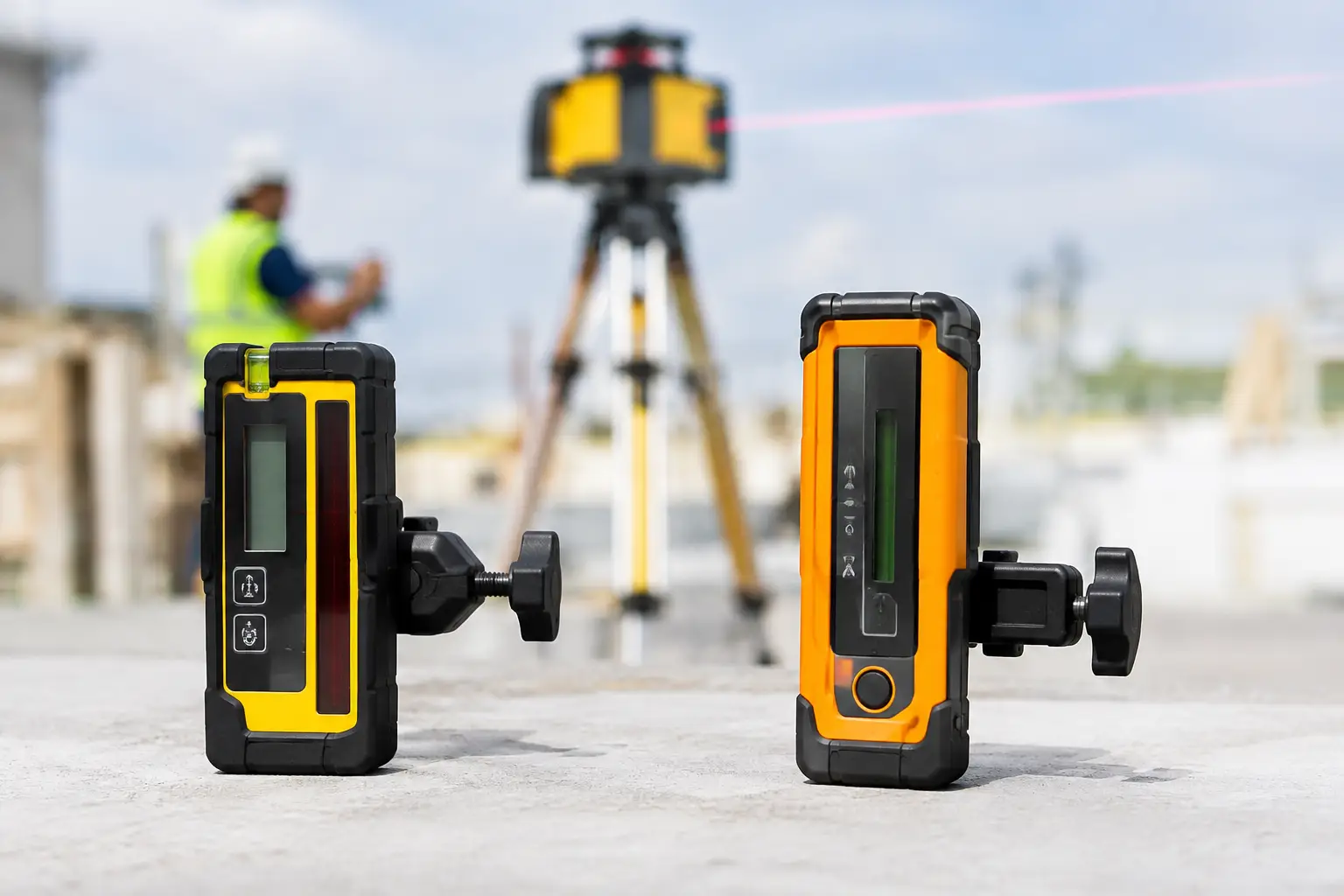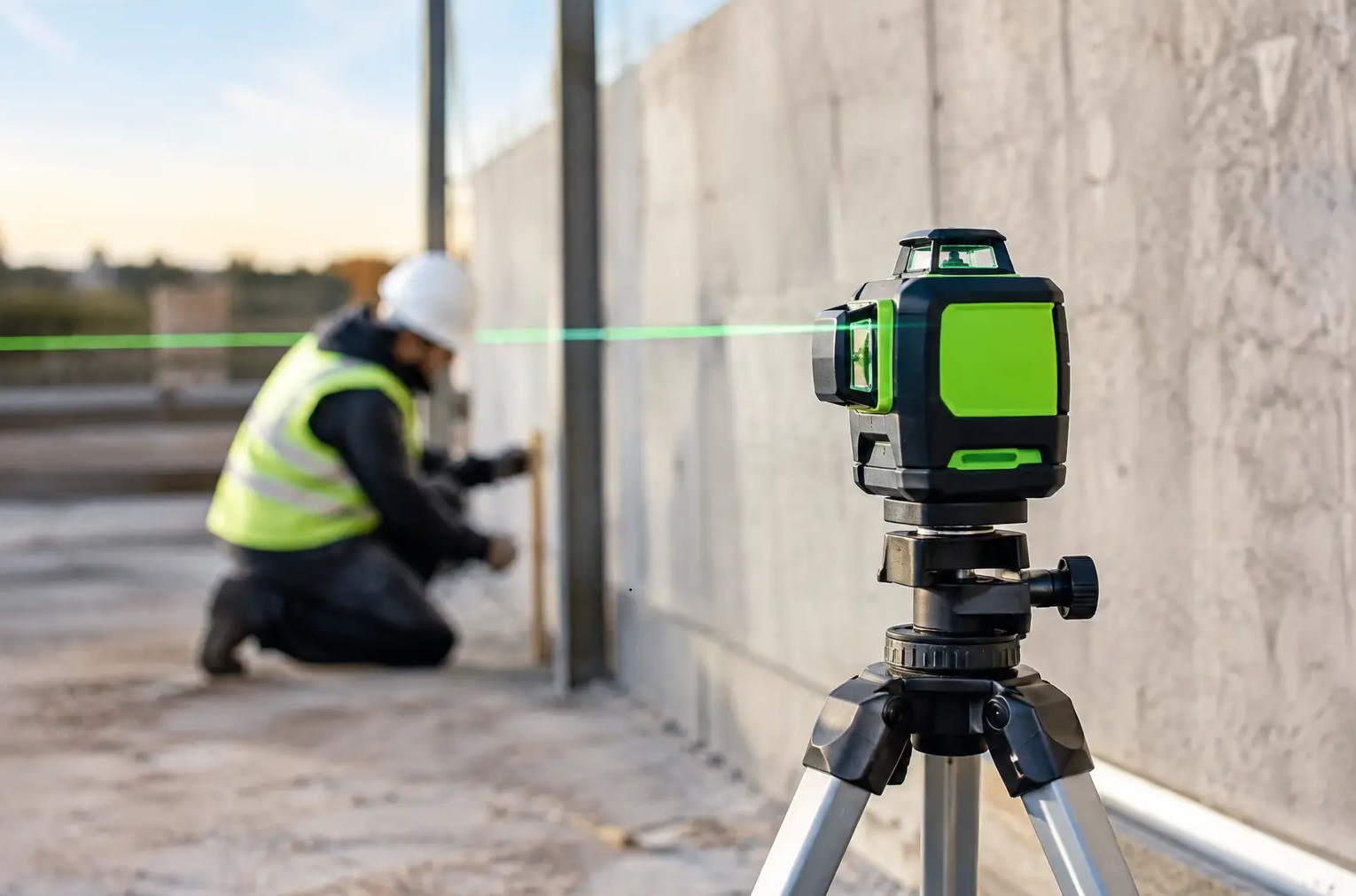
When concreting a foundation slab, digging a sewer or preparing the terrain, the result is not determined by the color of the device, but by whether you can read the height quickly even in direct sunlight. If you are deciding which laser to choose for the exterior , in most cases you need a rotating laser with an external receiver, a solid tripod and a leveling staff. A cross laser can be used for short work near the house, but on an open construction site, a rotating laser has a much wider range of uses.
Why is a rotating laser suitable for outdoors?
The rotating laser creates a horizontal plane across the entire work area. The head rotates and the beam is therefore captured by a receiver placed on a staff anywhere around the device. When doing earthworks, building foundations, setting curbs or checking the height of formwork, you do not have to constantly carry the laser and look for the direction of the beam again.
Unlike a regular cross laser, you don't have to rely on seeing the line with your naked eye when working outdoors. Sunlight will shine through the laser beam, and this applies to both the red and green beams. An external receiver picks up the rotating beam, guides you up or down with sound and a display, and allows you to accurately mark the desired height on the staff.
The practical basis for the exterior is the automatic self-leveling rotating laser. After being placed on a tripod, it levels itself within its range. When no one moves the tripod, you work without manual adjustments. For routine construction work, this is the fastest way to a reliable horizontal plane.
Which laser to choose for exterior use depending on the job
First, determine whether you need just a flat surface or a controlled slope. This difference has a greater impact on price and practicality than the color of the beam.
Foundations, slabs, curbs and common heights
For foundation strips, formwork, concreting, terraces, fences, curbs or height control when placing soil, a standard rotating laser with automatic leveling is sufficient. You set the device on a tripod, attach the receiver to a staff and transfer the reference height after construction.
Pay particular attention to the leveling accuracy, working range with the receiver, and the quality of the receiver. For a reasonably large family home or a typical field project, it is more important to have a complete functional set than to buy the laser itself and then improvise with an unsuitable batten or holder.
Sewers, drainage and paved areas
If you regularly grade, choose a digital rotary laser with X and Y slope adjustment. It will allow you to enter the desired slope in one or both directions. This can be used for sewer connections, drainage, parking lots, gutters, access roads, and terrain modeling.
A regular self-leveling model will create an exact horizontal plane, but you need to deal with the slope in a different way. For occasional drainage, a simple procedure with calculating the height difference may be enough. However, if you do slopes frequently, a digital model will save time, reduce the risk of error and allow you to repeat the adjustment exactly according to the project.
Pay attention to the function labels. Manual mode does not automatically mean digital input of the slope in percent. When purchasing, check whether the laser allows you to adjust the X and Y axes separately and to what extent.
Red or green beam outside?
The green beam is perceived more clearly by the human eye, so it is more pleasant when working indoors, in the shade or at short distances around the building. However, when choosing an outdoor rotating laser, the green color should not be the main reason for choosing it. In bright sunlight without a receiver, you will not be able to reliably see the green line even at a greater distance.
A red rotating laser with a high-quality receiver is therefore the right, cost-effective choice for many construction and field work. The green model makes sense if you will also use it for assembly, drywall, window installation or in partial shade, where you will appreciate better beam visibility.
Make your decision based on your actual working conditions. If the laser is mostly in an open area and you are reading the values on a staff, invest in a good receiver, with sufficient range and complete accessories. The color of the beam is only a secondary decision.
The receiver determines both comfort and accuracy of work
The receiver is not a small item to pack. It is the working part of the set, through which you read the height during outdoor leveling. The basic receiver guides you to the center of the beam with arrows or sound. This is enough for many jobs and you mark the height in the classic way according to the reference line on the staff.
The digital receiver with millimeter readout shows the deviation from the plane directly on the display. When checking an excavation, subgrade, concrete or slope, you can immediately see how many millimeters you are above or below the desired height. You don't have to guess the position based on the arrows or repeatedly move the staff until you hit the center.
A digital sensor is not a necessity for everyone. For the tradesman who pulls out the laser a few times a month to check curb heights, a standard receiver is practical and affordable. For the crew who digs, compacts, concretizes or checks elevation points daily, a millimeter reading will come in handy at work speed.
Range is not just a number on the box
Manufacturers list the working diameter or range with the receiver. When comparing models, always note whether this is the diameter of the entire circle or the distance from the laser to one side. A figure of 500 meters in diameter usually means a working radius of 250 meters from the device.
For family homes, smaller halls and most common projects, you don't need to buy an extreme range just because it looks better in terms of parameters. It is important that the receiver works stably, the tripod holds its position and the battery lasts a working day. A longer range is worth it for larger plots, roads, long excavations or when the laser is located outside the area where the equipment is moving.
Judge accuracy together with the working distance. A small deviation will naturally be more noticeable at a greater distance. For precise heights, therefore, place the laser as close as possible to the measured surface, but away from machine movement, vibration and the risk of impact.
Durability, power and equipment you'll feel on the jobsite
An outdoor laser is designed to work in dust, occasional rain and normal handling in a car. IP54 protection is a practical basis for construction equipment - it protects against dust in quantities that would interfere with the function, and against splashing water. However, this does not mean that you can leave the device in a downpour, put it in a puddle or wash it with pressure water.
Also look at the power supply. A rechargeable battery is convenient for regular work, especially if you have a charger in the kit and the option to buy a spare power supply. For long projects, it is worth having a second battery ready in the suitcase. Delays due to a discharged laser usually come exactly when the excavator, mixer or the entire assembly team is waiting.
The tripod must be reasonably sturdy and the staff legible. A cheap, lightweight tripod may fall on soft ground or move when touched. When working with a digital receiver, use a staff with a solid mount so that the sensor does not slip and you do not measure a different height just because of looseness in the mount.
The complete set has another advantage: all parts are designed for each other. The laser, receiver, holder, tripod, battens, case, charger and instructions form one functional unit. When purchasing separately, it is easy to find that a suitable holder is missing or the receiver range does not match the laser used.
Calibration and service are not a detail after purchase
Even a quality rotary laser is only accurate if it is properly calibrated. Its accuracy can change during transport, dropping or prolonged use. A device calibrated before sale gives you the assurance that you are starting work with a proven setting, not with technology that you must first check on the construction site.
You can do a simple check yourself. Place the laser between two walls or points, mark the height on one side, rotate it 180 degrees and compare the measured values according to the procedure in the manual. If the results do not match within the allowed tolerance, the device should be calibrated, not used for further work with an uncertain result.
When choosing, therefore, also ask about the availability of spare parts, batteries, holders and after-warranty service. A laser is not a disposable tool. Rotary Lasers - Levels provide pre-calibrated devices, service and personal training, which makes sense especially if you want to use the device to its full potential from day one.
Before ordering, try to answer one practical question: will you most often transfer heights or adjust slopes on the construction site? This will determine whether a self-leveling rotating laser with a receiver is enough for you, or whether a digital model is worth it. The correctly selected set will then not be left in the suitcase - it will save time with each marked height.