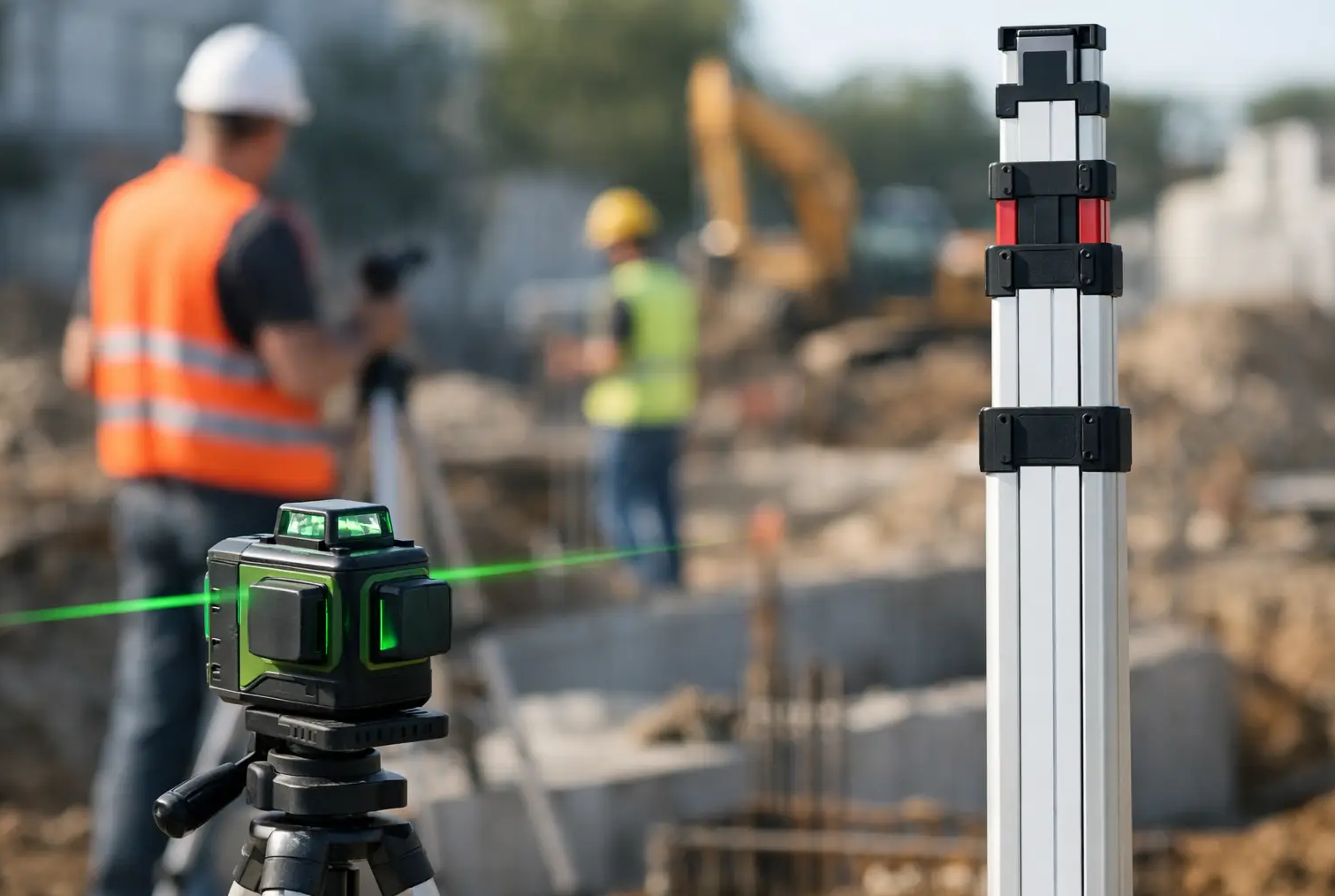
When concreting a foundation slab, digging a sewer or modifying the terrain, millimeters are often decisive. A rotating laser will determine the plane, but without a properly used staff, the worker has no way to safely transfer the height to a point in the terrain. The 5-meter telescopic leveling staff provides sufficient range for most common construction and assembly work and, when folded, fits comfortably in a car.
This is no ordinary measuring stick. The staff must support the receiver firmly, maintain a vertical position, and allow for a quick, legible reading. If it is chosen poorly or handled carelessly, a high-quality, calibrated rotating laser alone will not save your accuracy.
When is a 5-meter telescopic leveling staff the right choice?
The 5-meter length is practically universal. It is suitable for building foundations, setting formwork, checking the height of concrete, laying interlocking paving, landscaping and checking excavations. It has a reserve where the laser is placed higher on a tripod or where you measure from a lower excavation.
A shorter staff can be lighter and more convenient for interior installations. However, on an open construction site, you often encounter a situation where you need to move the receiver higher, but the staff already ends. Then the measurement is delayed by improvising and transferring the height to auxiliary points. With a five-meter staff, this problem usually does not arise in standard work.
The longer model makes sense for deeper excavations, retaining walls or specific field work. However, you have to take into account the higher weight and greater deflection if you hold it incorrectly. For a craftsman or construction company that needs one working batten for most jobs, the 5-meter telescopic version is a reasonable compromise between reach and handling.
The batten, receiver and laser must work as one unit
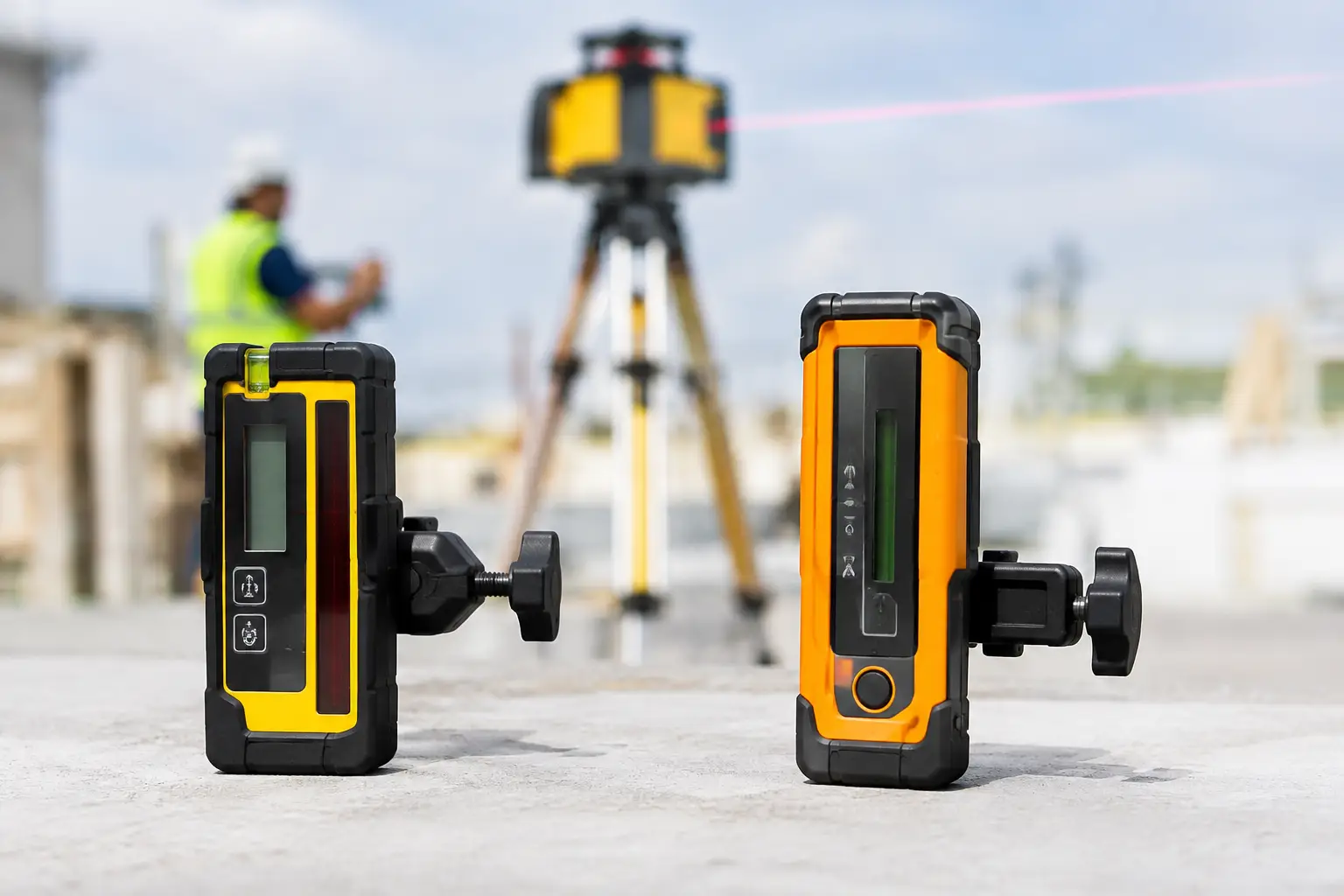
When working outdoors, you don't read the laser beam with your eyes. In the sun, both the red and green beams are usually invisible at a greater distance, so an external receiver is required. This is mounted in a holder on the staff, captures the rotating beam and indicates with an audio or visual signal whether the receiver needs to be moved up or down.
A regular receiver is sufficient where you need to maintain the height within the tolerance of normal construction work. For more precise placement, slopes, height differences or checking finished layers, a digital receiver with millimeter reading helps. Instead of guessing between the lines on the staff, you can see the deviation from the plane directly in millimeters.
The holder is also important. It must match the width and profile of the batten, be tightened firmly and must not slide along it during work. Play in the holder means an uncertain reading. When buying a kit, it is worth checking whether the holder is compatible with a specific receiver, not just with the batten in general.
Reading the scale without unnecessary errors
On the leveling staff, the scale is oriented so that the height of the receiver can be conveniently read from the bottom edge of the staff. The higher the receiver is on the staff, the higher the reading. So, when transferring the same height, the worker moves the receiver until the device reports the center, and then compares the reading on the scale with the reference point.
For example, if the reference point gives a reading of 1.420 m and you want the same height at the new location, the receiver must show the same value after being set to the center. With a difference of 30 mm, you know that the point in the terrain is higher or lower depending on the direction of the difference. With a digital receiver, the evaluation is even faster, but the principle remains the same.
Do not adjust the receiver only approximately according to the sound. After capturing the center, always check its position, tightening of the holder and readability of the scale. When concreting or sloping the sewer, a small error can be reflected in the entire length of the implementation by repeated transfer.
How to work with a telescopic batten in the field
Extend the telescopic sections smoothly and only to the required length. If you are measuring the normal height at curbs, paving or foundation strips, there is no point in extending the entire five meters. A lower extended batten is stiffer, holds better in a vertical position and suffers less in wind.
Place the bottom part on a solid point. Soft soil, fresh fill or gravel can change the position of the staff by a few millimeters during the measurement. Therefore, when working on the ground, first press the area under the staff, or use a solid pad. If you are checking the bottom of the excavation, also pay attention to stones and unevenness under the heel of the staff.
Hold the staff vertically. It is not always enough to estimate this by sight when the staff is extended. Many staffs have an integrated bubble, which will significantly speed up the correct setting. If a bubble is missing, a short cross level or checking from two directions will help. A tilted staff will show a larger reading than the actual vertical distance.
In windy conditions, work in pairs, especially if the batten is extended beyond three meters. One person holds the batten and monitors the verticality, the other reads the receiver or controls the terrain adjustment. It is not a delay. It is cheaper than correcting the height of a poorly made layer of gravel or concrete.
Material, profile and scale determine the service life
A working telescopic staff is most often made of aluminum. It is light, durable and tolerates moisture and dust well in normal use. A cheap thin staff may bend more significantly when fully extended, may have inaccurate locks or its scale may be quickly damaged. This may not be a major problem for occasional measurements, but it is for everyday work.
Pay particular attention to the strength of the individual segments, the quality of the locking and the contrast of the scale. The red and black scale on a light background must be readable even in mud, dust and poor light. If the worker guesses the reading, the accuracy of the laser has no practical significance.
A receiver staff is not the same as a geodetic code staff or a regular extendable pole. For a rotary laser, you need a model with a scale and a profile designed to attach the receiver holder. Therefore, before ordering, check what type of measurement you are doing and what accessories you already have. Not every five-meter pole will solve height measurements on a construction site.
Maintenance that takes less than ten minutes
After work, slide the batten in and wipe it dry, especially between the telescopic parts. Dried mud and fine sand damage the locks, make it difficult to extend and can scratch the scale over time. Do not leave it lying in water for a long time or subject it to unnecessary impact in the back of a car.
Regularly check that the segments do not slide in by themselves and that the receiver holder is held in the desired position. After a heavy fall, check the straightness of the profile and compare the measurement at a known point. Although the staff does not have electronics, a crooked profile or a damaged scale can ruin the entire leveling process.
The most common errors when measuring heights
The first mistake is measuring without a reference point selected. The laser creates a plane, but it itself does not tell you whether you are at the correct height relative to the project. First, determine the point with the desired dimension, read it off, and only then transfer the height further.
The second mistake is to confuse direction. A higher reading on the staff does not automatically mean higher ground. It means that the receiver is higher above where the foot of the staff is. If the laser plane is still the same, a higher reading usually indicates a lower point in the ground. Always check this on a simple test point, especially when guiding an engineer on a dig.
The third mistake is relying on an unverified device. Before starting important work, check the rotary laser at a known point or perform an accuracy check according to the instructions. When purchasing, it is an advantage when the device comes pre-calibrated. Rotary Lasers - Levels deliver the devices calibrated and in the following years of use you can handle service and accuracy checks without unnecessary searching.
Which assembly to choose for a regular building
For most outdoor jobs, an automatic self-leveling rotating laser, an external receiver, a fixed mount, a tripod and a 5-meter telescopic staff make sense. The red beam is a cost-effective option if you work mostly with the receiver. The green beam is better visible at shorter distances and indoors, but it is also not a substitute for the receiver in sunlight.
If you are doing sewers, paved areas or terrain with a precisely defined slope, choose a digital receiver and, depending on the scope of the work, a laser with slope adjustment in the X and Y axes. The battens themselves will be the same basis for measurement, but a more accurate reading will save you from constant recalculations and guesswork during implementation.
The five-meter telescopic staff has a simple job on the construction site: to reliably transmit information from the laser to the ground, formwork or structure. When you hold it vertically, use a solid mount and check the reference point, it becomes one of the most practical pieces of equipment you have when working with a rotating laser.